Under-used PJM grid interconnection points could fast-track 24 GW of storage

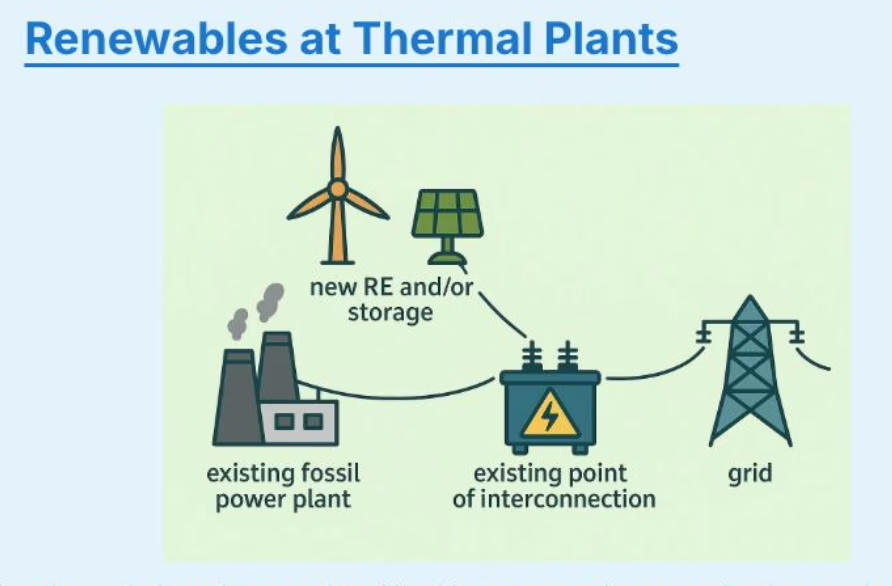
In the PJM grid region, 102 GW of solar could be deployed by sharing interconnection points used by fossil-fuel-powered generators operating below 15% capacity factor. Similarly, solar and wind sites which use as little as 19.1% of the capacity of PJM’s interconnection points could boost that rate to 75%, for solar; or 83%, for wind, with the addition of six-hour energy storage.
That is the conclusion of a working paper by two University of California researchers.
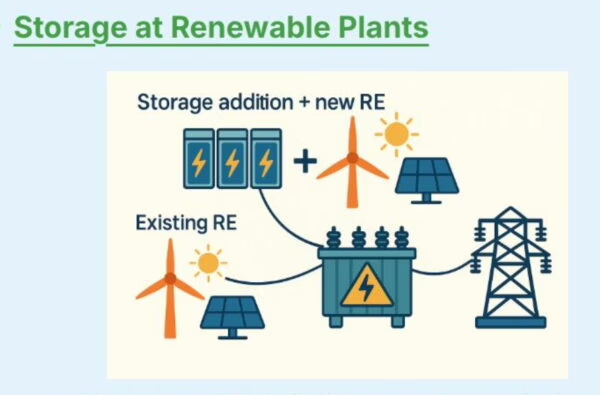
Solar and wind plants in the region could host 24 GW of storage which could be charged by new renewable energy generation sharing the point of interconnection.
These amounts of solar and storage, plus 28 GW of wind power, could be added without building new transmission infrastructure, and could bypass PJM’s “congested” interconnection queues, the researchers say.
To illustrate the concept, the paper provides the two images shown below. At any given time, the combined output of the generators sharing a point of interconnection could not exceed the capacity of the point of interconnection. The second image illustrates that adding storage at solar sites enables more solar at those sites because the added batteries store the additional solar electricity for discharge at night.
The researchers report that PJM has 95 GW of solar capacity “stuck” in its interconnection queues, along with 37 GW of standalone storage capacity and 25 GW of wind capacity.
The clean energy additions available through shared points of interconnection could connect to the grid within one to two years, the researchers say, compared to five to seven years for projects needing a new point of interconnection.
Adding clean energy by sharing interconnection could help address a “looming” 25 GW capacity shortfall in the PJM region by 2030, a figure which is largely due to data center demand, the researchers say. They add that natural gas plants ordered now are unlikely to be operational before 2030 to 2032.
A PJM spokesperson said that “PJM continues to advance initiatives to make it easier to leverage existing interconnection capability, such as changes to Surplus Interconnection Service, which the Federal Energy Regulatory Commission approved to utilize the unused portion of interconnection service for facilities that do not operate continuously.”
Buildable
A dashboard accompanying the working paper shows plant-level details on surplus interconnection potential. “If you select a plant from the left filters [of the dashboard], you can also see the land-use button pop up on the right-hand side,” said researcher Umed Paliwal. “Clicking that button shows land use near the plant.” The land uses are color-coded, with one color indicating buildable areas for clean energy projects near each potential shared point of interconnection.
Among the paper’s policy recommendations are:
- PJM should create a pro forma Surplus Interconnection Service Agreement, modeled on one used by grid operator Midcontinent Independent System Operator.
- Federal regulators and PJM must create a clear pathway for a surplus user to obtain permanent interconnection rights when a host generator retires.
California and nationwide
A similar paper from UC Berkeley, on sharing points of interconnection in California, prompted a proposal for the state to act promptly to ensure that clean energy developers could quickly add 23 GW of renewables.
Nationwide, sharing points of interconnection could enable 500 GW of solar, a team of UC Berkeley researchers reported last year.
The new paper, focused on PJM, is titled “Existing power plants sharing grid access with new resources can lower costs and double PJM’s generating capacity.”
From pv magazine USA.
Written by




Popular Posts