Storage, e-mobility drive Huawei Brazil strategy

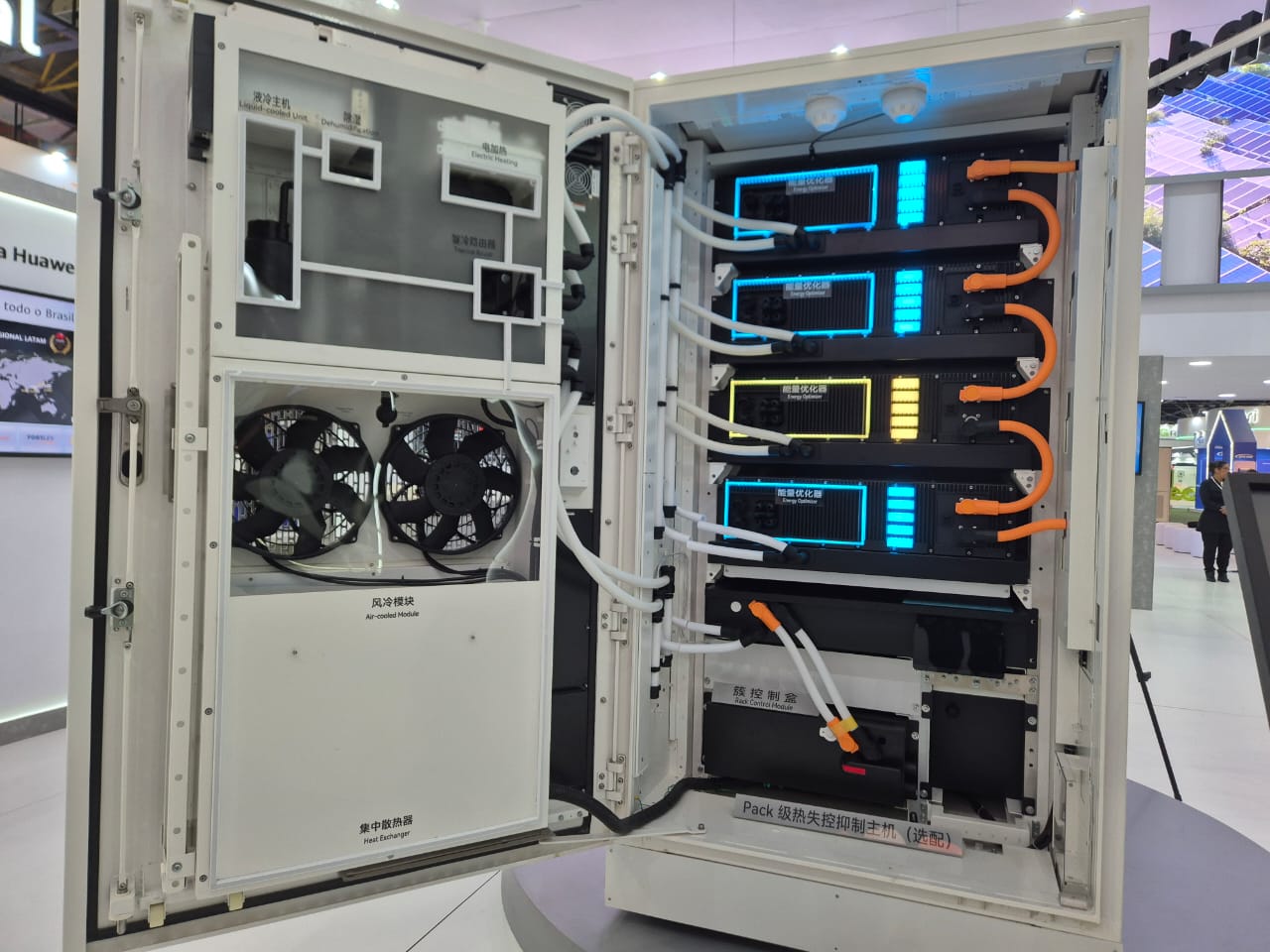
Huawei Digital Power Technical Director Roberto Valer and Matrix Energia Commercial Manager Gledson Torquato discussed industry trends and Huawei’s approach in Brazil with pv magazine at Intersolar 2025, against the backdrop of a Huawei booth resembling the trade show entrance itself.
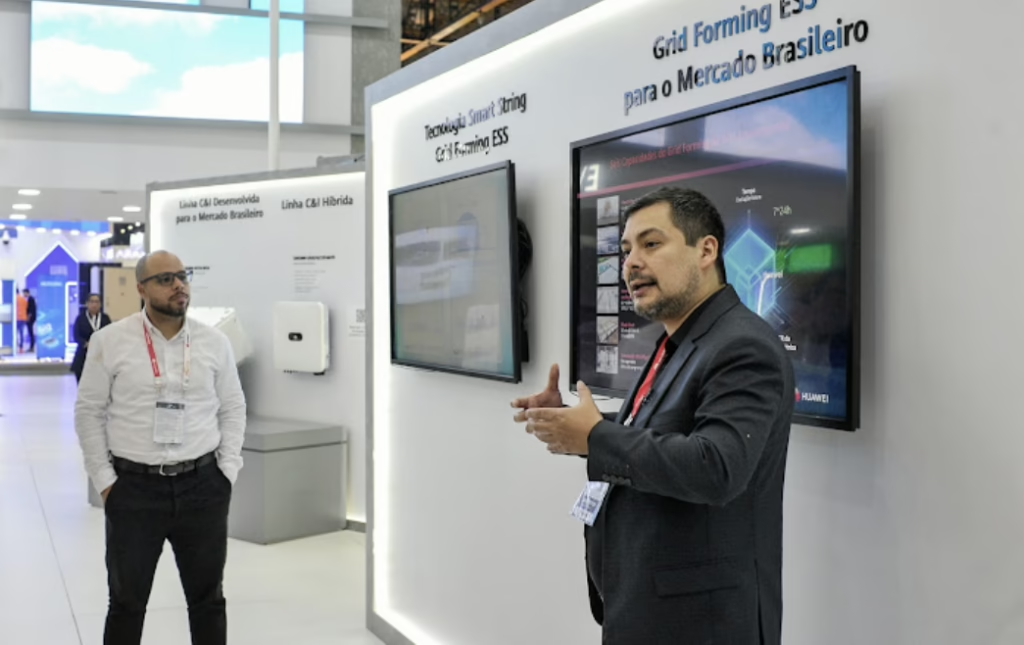
Valer highlighted transformation in the energy sector, stating, “The major trend at Intersolar, already observed at SNEC, is the strong presence of batteries. This specific model has great sales potential in Brazil.” Valer noted the country has around 680 MW of storage systems, 70% of which are off-grid, and said the technology is beginning to gain traction in larger applications.
“We’re already seeing batteries being used in energy arbitrage, backup for residential and industrial customers, contracted demand reduction, irrigation, and even replacing diesel generators,” said Valer. He cited a project in the Amazon, saying, “It’s a region that relies heavily on diesel but transportation logistics are difficult. This storage system, combined with solar energy, helps reduce this dependence and is in line with the government’s efforts.”
Third energy revolution
Valer referred to a third revolution in Brazilian energy consumption, stating, “The first revolution was the creation of the free market, allowing access to large consumers. The second was distributed generation, which paved the way for small consumers to generate their own energy. The third, now, is storage, which provides true energy autonomy.”
With storage offering savings, safety, and independence from utilities, Valer said, “Last year we installed almost 70 MW for customers and have already evolved to more compact and efficient hybrid technologies, with decreasing costs, just as we did with solar panels.”
Technological advances include mixed cooling, for improved performance; and a modular, containerized storage product with integrated power control- and energy management systems. Valer also touted the ability of “grid-forming” storage projects to provide the sort of system inertia usually sourced from large hydroelectric plants. “This innovation has already been tested in different scenarios around the world, such as in the Red Sea and the Philippines, in large-scale projects,” said the executive. “Regulation in Brazil still needs to advance but this type of application is already a reality in [markets] like Australia, Europe, and Chile.”
E-mobility
Matrix’s Torquato emphasized the importance of integrating storage and e-mobility, especially in public transportation. He cited the challenges faced by bus depots in São Paulo which can lack sufficient charging infrastructure.
“With storage systems, we can charge the batteries during the day and use the energy when recharging the buses,” said Torquato. “This means that a depot that couldn’t charge any vehicles can now charge seven, eight, or even dozens of buses, depending on the installed capacity.”
The charging systems feature Huawei storage, power units, and high-power dispensers, and a pilot project has been operating in São Paulo for over a year, offering fast charging and longer battery life.
When it comes to safety, Torquato said, “All of our solutions exceed international requirements. Just as we did in the past with technologies like AFCI [arc-fault circuit interruption], today we promote higher standards in batteries, considering safety even before it becomes mandatory.”
Beyond mobility, the systems are being applied in meatpacking plants, mining companies, and expanding industries. “The customer doesn’t need to invest in all capacity immediately,” said Torquato. “They can start small and expand as demand demands. This provides financial and operational flexibility.”
Ultra-fast chargers
Huawei also announced an ambitious goal of selling 100 Power Units and 400 ultra-fast charging dispensers in Brazil by the end of 2026.
Valer said the strategy is aligned with growth of the country’s EV fleet. The Brazilian Electric Vehicle Association has estimated the nation surpassed 400,000 EVs last year. In the first quarter of 2025, the market grew 10%, with nearly 40,000 units registered.
“When we brought this technology to Brazil, in 2024, we presented a vision,” said Valer. “Now, in 2025, we’re talking about implementation and scale. Our goal of 400 dispensers is ambitious but it reflects the market’s urgency and our confidence in our solution, already in operation with São Paulo’s electric bus fleet.”
The new chargers offer a recharge equivalent to 200 km of range in just five minutes. The solution is based on a 720 kW power unit, scalable to up to 12 simultaneous charging points, with liquid cooling and load balance technology which intelligently distributes energy among connected vehicles.
Decarbonization
For Huawei, the combination of ultra-fast charging, solar generation, and battery energy storage systems is the key to enabling large-scale electric mobility in Brazil.
“Electric mobility doesn’t work without a robust energy ecosystem behind it,” said Valer. “Our advantage lies in integrating ultra-fast charging with solar and battery storage, offering a complete, intelligent, and sustainable solution.”
The Huawei and Matrix representatives emphasized storage is no longer a promise but a rapidly expanding reality in Brazil, Valer adding, “We are facing an energy revolution and storage is a central piece of this process.”
From pv magazine Brasil.
Written by


Popular Posts