Seven views on Italy’s first MACSE auction: Too soon to call it revolutionary?

As Terna publishes the list of successful bidders in Italy’s first MACSE auction, industry experts are weighing the outcomes and delivering insights. Some highlight benefits for the system, such as lower costs, while others warn of unexpectedly thin margins for operators. One point of consensus is that total investment in batteries is set to reach around €1 billion over the next 39 months.
Virginia Canazza, partner at Key to Energy (KtE), underlined both the reduction in CapEx for electrochemical storage and the strategies of utility players.
“In this highly competitive context, the results showed that utilities were the main protagonists. They face fewer financing constraints than independent IPPs and can rely on strong bargaining power in technology procurement, economies of scale, and extensive, diversified portfolios. These factors allow them to set effective strategies and better protect against risk,” said Canazza.
According to nTeaser, Enel Produzione was awarded 5.2 GWh, while ACL Energy was awarded 2.1 GWh. They were followed by Solar Challenge 4 (832 MWh), Whysol Investments (570 MWh), Greenvolt Group/V-Ridium Solar Sicilia (499 MWh), Eni Plenitude Storage (455 MWh), and Scara Energia (250 MWh).
She added that falling CapEx has significantly reduced the Cost of New Entry (CONE), a key metric for regulated storage revenues. But she warned: “It is worth noting that the main component of these assets is supplied by only a few large Asian manufacturers. Given the volatility of CapEx over the past three years, this requires particular attention going forward.”
KtE also pointed to the wide gap between awarded prices and the reserve price set by regulator Arera only three months ago at €37,000/MWh/year.
“There is no doubt that bidding strategies took into account the opportunity for additional revenues from merchant activity, parallel to the regulated business and beyond the contracted MACSE period. These elements certainly boosted returns by more than a percentage point. It should also be noted that hybrid strategies (merchant/regulated) will require advanced energy management to extract maximum value from these dispatchable assets,” Canazza said.
For Mauro Moroni, the auction marks a turning point: “Storage is no longer a laboratory experiment; it is already a full engine of the energy transition. Renewables together with storage are highly competitive in Italy—not tomorrow, but now.”
Francesco Orecchia, data expert at Italia Solare, echoed this view: “The first figures show a weighted average premium below expectations. As Italia Solare, we are evaluating how best to interpret this result. We can say that the programmability of renewables will come at a limited cost, one likely to fall further given the projected decline in battery prices.”
Aurora Energy Research: upside and downside of fierce competition
A deeper understanding of the auction requires looking at marginal prices (only averages have been published thus far), project durations, and how the awarded capacity is distributed among bidders.
This analysis could reveal, for example, whether capacity was concentrated among operators that pursued particularly aggressive strategies, Matteo Coriglioni, head of Italy at Aurora Energy Research, told pv magazine Italy.
“The large participation—four times the offered capacity—put strong competitive pressure on operators. On the other hand, extreme price levels observed in the South imply margin erosion for operators and suppliers well beyond expectations,” Coriglioni said.
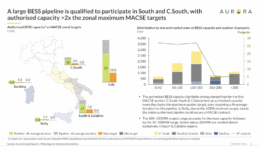
The weighted average clearing price was €12,959/MWh/year: €14,566/MWh/year in Central South, €12,146/MWh/year in South and Calabria, €15,846/MWh/year in Sicily, and €15,029/MWh/year in Sardinia—all well below the €37,000/MWh/year reserve price.
Awarded capacity matched the 10 GWh on offer, with South and Calabria filling their maximum quota of 7 GWh, Sicily and Sardinia each at the 500 MWh minimum, and Central South at two-thirds of its 2 GWh maximum. Less contested zones showed higher marginal prices: Sicily at €18.8k/MWh/year, Sardinia and Central South at €16.6k/MWh/year, and South and Calabria at €14.8k/MWh/year, according to Francesca Egidi, partner at KtE.
She added that the awarded projects had an average energy-to-power ratio of 6.5–7.5 hours, in line with the best configurations KtE had analysed when preparing bidding strategies.
For Coriglioni, the picture is mixed: “The good news is that the auction was a success, and the first MACSE tranche will come at a relatively low cost for the system. The risk is that the scheme’s ability to attract investments in later rounds could be reduced, with more operators opting for smaller assets and alternative business models.”
Egidi offered a slightly different take: “Beyond the clear opportunity to await future MACSE rounds, the increased competitiveness of full-merchant models—thanks to a sharp contraction in the levelized cost of storage—opens the way for interesting and profitable commercial alternatives. These could be in stand-alone or RES-coupled form, managed directly by IPPs or through innovative risk-mitigation contracts such as tolling. The upcoming Capacity Market auctions may provide further growth opportunities, with storage already able to compete directly with conventional plants at these levels.”
Merchant alternative
BESS projects contracted under MACSE will only come online in 2028, while merchant projects face no such delay. This, combined with the price dynamics, allows a comparison that suggests new capacity could enter the market independently of MACSE, said Gabriele Franzè, country manager of Inxieme Energia.
“If we assume an average of 1.2 cycles per day, the awarded value of €12,959/MWh would imply margins of €29.6/MWh on markets. Current spreads are far higher, averaging around €80/MWh, and are expected to stay at that level in the medium term. While BESS penetration tends to flatten the price curve, renewable penetration steepens it in line with the classic duck curve,” Franzè wrote on LinkedIn.
He concluded that the merchant option appears “much more interesting and competitive” than MACSE. Still, MACSE sends a strong signal—particularly to those advocating for nuclear investment.
“With Terna’s first MACSE auction, we can say the era of strategic storage has begun,” said Giovanbattista Napolitano, technical director at Wattkraft, also on LinkedIn.
For the more than 30 GWh of capacity left out, experts agree there will be multiple avenues and opportunities.
From pv magazine Italy.
Written by




Popular Posts