Alsym Energy launches Na-Series, claiming safe, low-cost sodium-ion battery storage


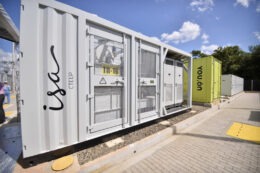
US-based battery developer Alsym Energy has officially announced its new Na-Series line, a sodium-ion battery aimed at the stationary energy storage market. The company based out of Massachusetts is centering the product on safety, supply chain security, while not forgetting cost.
Alsym claims its “proprietary” sodium-ion formulation is “non-flammable” and “non-toxic.” Without the company acknowledging it (the word lithium was not in the press release), this is a clear differentiator from lithium-ion batteries, which carry thermal runaway risks due to the volatility of liquid lithium electrolytes.
Alsym, talking about the safety profile, says it will enable confident deployment in dense urban areas, including rooftops and basements, and will “ease permitting approvals,” a significant pain point for project developers where many conditions on developments are placed for fire suppression and control.
On the cost front, Alsym states the Na-Series will deliver a “lower LCOS” compared to “prevailing solutions,” which is attributed to its use of sodium as a more abundant and lower-cost element, and a reduced need for expensive auxiliary systems, such as complex fire suppression.
The company also focused on its “non-FEOC sourced materials,” positioning the technology as a supply-secure alternative for integrators in North America and Europe, while noting that a 0% State of Charge is safe for storage and transport, via aluminum current collectors that avoid dissolution issues as the copper used in lithium-ion.
CEO and co-founder of Alysm, Mukesh Chatter, described the situation by saying, “Our batteries are exactly what is needed by the market right now, and can deliver peace of mind to homeowners, businesses, communities, and grid operators who are eagerly seeking safe and reliable energy storage solutions.”
Na-Series NFPP+ cells
While the safety and supply chain advantages are compelling, the focus for larger integrators and manufacturers of battery systems will be on the specs and testing.
Alsym has published technical specifications for its “Na-Series NFPP+” cells. Alsym lists its cell-level density at 135 Wh/kg and 250 Wh/L, with a cycle life of over 10,000 cycles (or a 20-year service life), high charge/discharge rates of 2C and 4C and a round-trip efficiency of over 95%.
The density is in line, as might be expected, with a lower result than current-generation lithium iron phosphate (LFP) battery cells. Recently, China’s Cornex showed off a 588 Ah cell that delivers a gravimetric energy density of 190 Wh/kg, a volumetric energy density of 419 Wh/L. Back in April, CATL showed off a 587 Ah high-capacity battery cell at 430 Wh/L .
The result will be that Alsym’s systems will require a larger footprint and be heavier for the same energy capacity.
The defined operating temperature range is -40 °C to 60 °C, wider than most lithium options. Alsym noted it is “advancing its commercialization roadmap” and that it is working with strategic partners, indicating it is not yet in mass production.
Written by