Field test: Tesvolt commercial storage generates five-figure monthly revenues

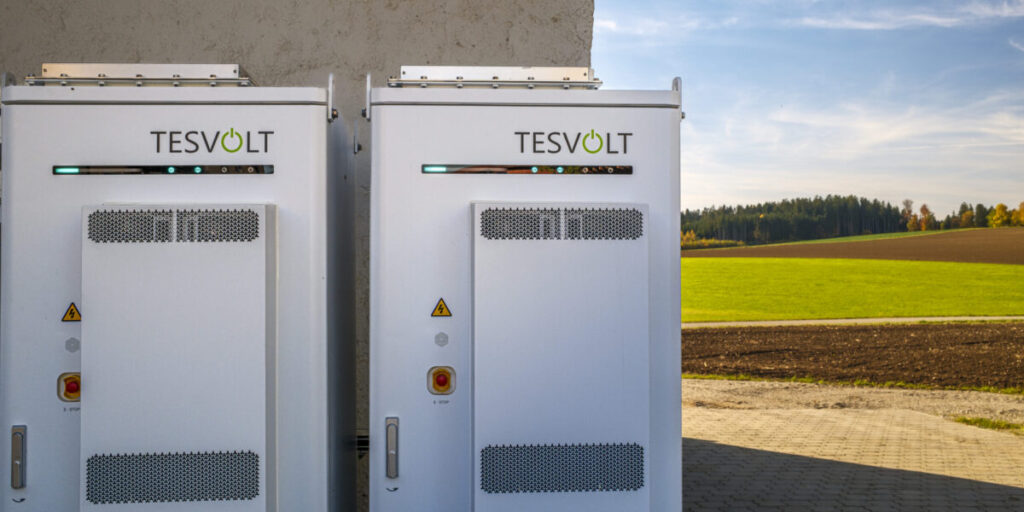
Following the spring launch of its new Forton commercial storage system, Tesvolt has released data from comprehensive field tests conducted over the past several months across ten distinct customer projects.
The German company reported that the results confirm high profitability for grid-service applications. “The battery systems used purely for energy trading are already generating monthly revenues in the four- to five-figure range,” Tesvolt stated. Additionally, the data confirmed that the hardware performs reliably in classic commercial and industrial (C&I) scenarios, such as self-consumption optimization and peak shaving.
Optimizing for the VPP
“Field tests are vital, especially when utilizing battery storage for energy trading. It significantly raises the bar for hardware, software, and technical support,” explains Leonard Friese, Product Manager at Tesvolt.
Friese noted that the learning curve was an essential part of the process. “We learned a great deal during these field tests. At the beginning, there were several technical hurdles, then only occasional minor issues, until finally, we reached the point where everything ran smoothly and consistently.”
One operational improvement involved the speed of commissioning. At the start of the pilot phase, digitally integrating the new commercial storage units into a Virtual Power Plant (VPP) took several days. Based on these early experiences, Tesvolt overhauled its project workflows and internal processes. According to the company, this integration procedure is now typically completed in just half a day.
Streamlining grid integration
Integrating commercial storage into a VPP is a prerequisite for aggregated participation in electricity trading, which maximizes revenue for operators. However, technical integration is only half the battle; regulatory coordination is equally critical.
“We also learned to engage with the responsible grid operators during the very early stages of project planning so that the start of [revenue generation] isn’t unnecessarily delayed,” said Tesvolt Product Manager Juri von Wilcken.
ROI and market response
Driven by revenues from electricity trading, Tesvolt projects that the storage systems can achieve a return on investment (ROI) in approximately five to six years.
To market the aggregated storage capacity, the company relies on partners Enspired, Entrix, and The Mobility House. These energy traders compete to secure the best returns, a dynamic that Tesvolt claims results in “particularly high revenues and lower risk” for the customer. The model is open to any site with a grid connection of at least 50 kW and a battery storage capacity of at least 50 kWh.
According to Tesvolt, the successful field test has triggered an uptick in orders, with a clear shift in how customers intend to use the assets.
“Two-thirds of all those ordering want to use Fortons for trading, while one-third are focusing on classic applications like self-consumption optimization and peak shaving which remains a lucrative option,” von Wilcken added.
Technical specifications
The Tesvolt commercial storage system is designed to handle two full cycles per day and comes with a 15-year performance warranty. The modular battery storage is available in increments of 92 kW power and 92 kWh capacity.
For scalability, up to four storage units can be cascaded behind a single inverter, and a total of 16 inverters can be connected in parallel. This allows the system to be configured up to a maximum capacity of 6 MWh with a power output of 1.5 MW.
From pv magazine Germany.
Written by




Popular Posts