Industrial batteries in France earn revenue by stabilizing the grid via secondary reserve (aFRR)

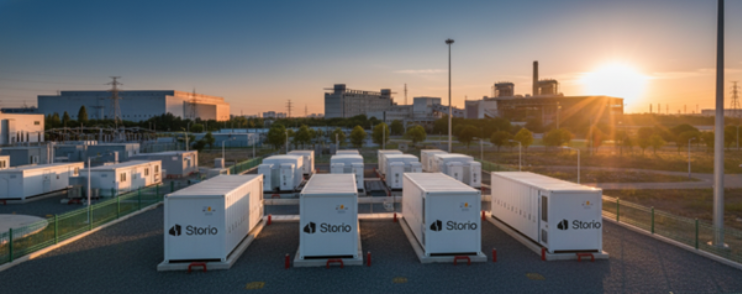
Storio Energy, which specializes in battery energy storage systems for large electricity consumers, has reached a new milestone in France by enabling its behind-the-meter batteries to participate in the automatic Frequency Restoration Reserve (aFRR). The aFRR is used to automatically correct deviations around the grid’s target frequency of 50 Hz. Until now, batteries providing aFRR services in France were almost exclusively front-of-the-meter, standalone systems connected directly to the transmission grid and equipped with dedicated meters.
“From the very beginning of Storio’s development, we wanted to demonstrate that behind-the-meter batteries could also contribute to grid stability, despite the technical challenges involved,” the company said. One such challenge is the absence of a dedicated meter, which traditionally prevents grid operators from monitoring BTM battery activity in real time.
To overcome these constraints, Storio Energy developed its own in-house energy management system (EMS) that complies with the strict technical requirements of grid operators, including latency, accuracy, and controllability. Unlike standalone batteries connected directly to the national grid, Storio’s systems are installed on the internal electrical networks of energy-intensive industrial sites. As a result, the battery’s energy flows are not directly visible to the grid operator and are treated as part of the site’s overall consumption profile.
According to Jean-Yves Stephan, co-founder and CEO of Storio Energy, the EMS plays a central role in enabling this participation:
“The EMS sends the battery’s energy flows to [transmission system operator] RTE in real time and follows RTE’s power instructions in the event of secondary reserve activation, fully complying with the operator’s technical specifications. Our artificial intelligence also forecasts site consumption, balancing needs, and energy market prices to optimize battery operation and maximize both energy savings and additional revenues for our customers.”
Operational and economic advantages
Unlike standalone storage systems, Storio Energy’s batteries share grid connections with industrial facilities. When a battery discharges, it reduces the site’s electricity consumption – an effect that is operationally equivalent to injecting power into the grid, without requiring additional injection capacity.
According to Storio, this configuration offers several advantages:
- No grid reinforcement or new substations are required
- No intervention by [France’s primary distribution system operator] Enedis or RTE is needed, as existing connections are used
- Significantly shorter deployment timelines
- Lower investment costs compared to standalone battery projects
Beyond ancillary services such as aFRR, Storio’s EMS enables multiple revenue streams, including spot price arbitrage, demand response, and optimization of the Public Electricity Network Usage Tariff (TURPE). For industrial customers, this can translate into electricity cost savings of 10% to 20%, according to the company.
On-site industrial energy storage is emerging as a rapidly expanding segment with substantial untapped potential. As Stephan concludes: “On-site industrial battery storage represents a tremendous source of flexibility for the electricity grid. The 1,000 largest industrial sites in France alone could provide up to 20 GWh of storage capacity—ten times more than all the energy storage currently deployed nationwide.”
From pv magazine France
Written by


Popular Posts