Winter Storm Fern: BESS faces first major scarcity test in ERCOT’s redesigned market

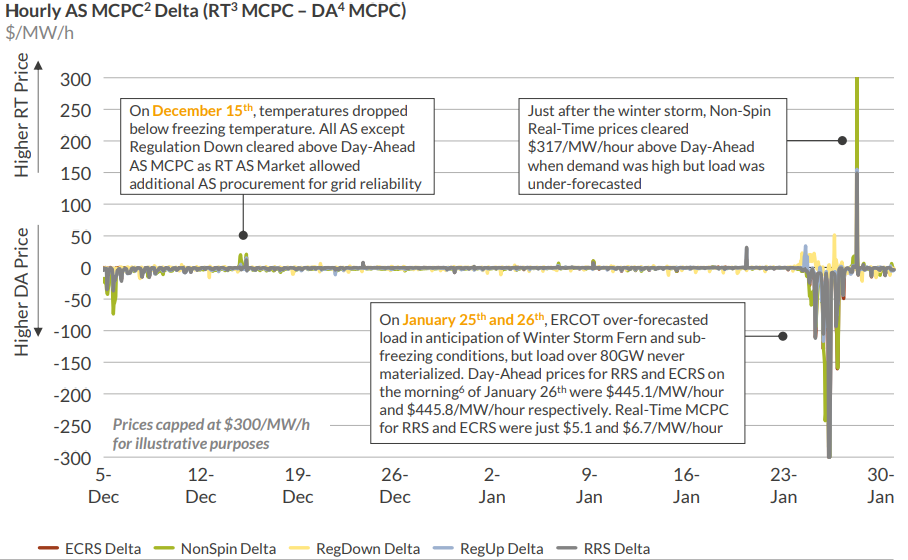
Merely a few months after the Electric Reliability Council of Texas (ERCOT) rolled out its long-awaited Real-Time Co-optimization plus Batteries (RTC+B) program, the overhauled market experienced its first scarcity event with January’s Winter Storm Fern. Energy prices surged, with average day-ahead ancillary services (AS) prices topping out over $100 per megawatt per hour at the storm’s midpoint.
Still, while there are only two months of data on the books, early data shared by Aurora Energy Research indicate that, under RTC+B, there could be “sustained value for batteries” regarding day-ahead AS pricing.
“RTC+B savings are derived from being able to shift the most cost-effective resources to providing energy when needed rather than having them sit in AS markets,” said Olivier Beaufils, the head of USA Central at Aurora. He told ESS News that now, those savings will be realized over the course of the year rather than concentrated in a few hours. Still, he pointed out that building a successful business case for battery storage in ERCOT relies heavily on earning high revenues on a limited number of scarcity days.
“In previous years, we have seen some batteries realize over 50% of their yearly margins during the top 10 highest priced days,” he added. Given this reliance on high price events, Beaufils said, “the expected impact of RTC+B will mechanically be smaller for those assets.”
“As the system is more efficient under RTC+B, we expect some erosion of the realized top-bottom spreads and ancillary services can capture on average,” he added. That’s part of why, from Aurora’s standpoint, though RTC+B is “slightly negative” for helping individual assets or projects pencil out, the scheme shouldn’t change the overall investment case for storage in ERCOT.
As of Q3 2025, ERCOT’s operational battery capacity clocked in at just under 20,000 MWh, though there are early rumblings of higher cancellation rates during the interconnection process. Still, the one-two-punch of increasing renewable penetration in the Texas grid and still-rising data center load growth is continuing to spur new battery projects in the Lone Star State.
It’s also making it harder to anticipate what’s next for the market.
“The combination is creating the need for very large net load ramps in the morning and evening,” explained Beaufils, meaning that forecast errors can result in several gigawatts of over- or under-procurement. That’s where flexible assets like batteries are continuing to prove their value in ERCOT, he said, as, unlike conventional baseload technologies that aren’t capable of fast ramping, “they can quickly provide energy or AS in real time to help manage those errors.”
Winter Storm Fern was one such scenario. Ahead of the storm, ERCOT’s DayAhead load forecast, which was the highest since August 2025, exceeded 85 GW. The actual load only reached 75.6 GW. According to Aurora, this was the highest over-forecast since May 2025.
Let’s do some math: a high actual load plus a high load over-forecast equals, in this case, the highest day-ahead market clearing price for capacity (MCPC) since May 2024. January 26th saw average day-ahead MCPC hit $107/MW/h for the day, as well as an hourly price of $1000/MW/h at 8 am for the ERCOT Contingency Reserve Service.
But, since RTC+B’s rollout, both energy and AS markets cleared below the 60 previous days when excluding the storm days and real-time AS consistently cleared at lower prices than day-ahead AS. It’s as yet unknown whether, or to what extent, these dynamics will continue.
“It will be important to watch the system dynamics and bidding behavior of assets over a longer period of time, especially over the summer, to have stronger conclusions,” said Beaufils.
Written by




Popular Posts