Greenlit ESS: Form Energy scores Irish win with 1 GWh iron-air battery to come online in 2029

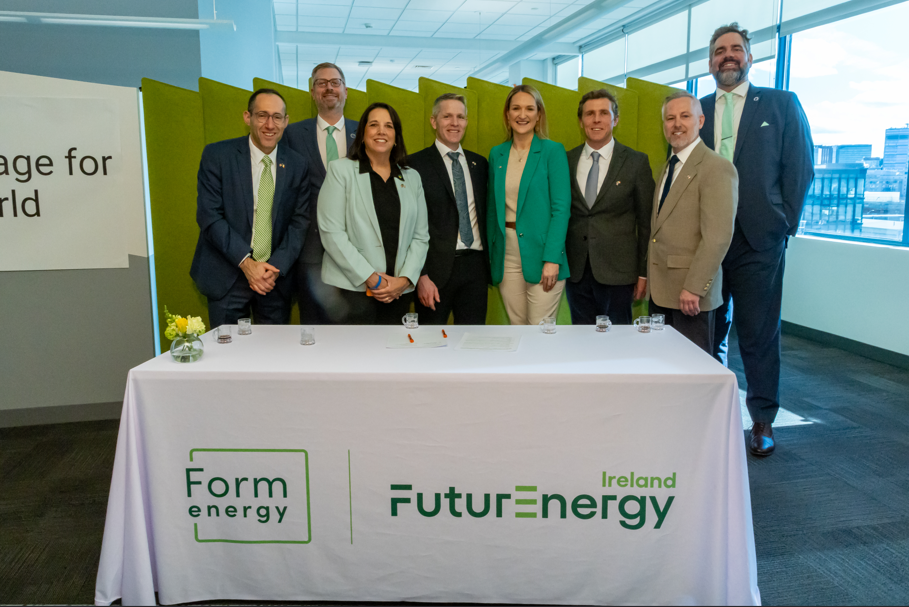
Form Energy has announced a partnership with Irish developer FuturEnergy Ireland to jointly deploy a 10 MW/1 GWh iron-air battery project in the northwest of Ireland. Planned to come online in 2029, the Irish battery – dubbed Ballynahone Energy Storage – will be the Massachusetts-based energy storage company’s first international deployment.
FuturEnergy Ireland proposed the 1 GWh iron-air project using Form Energy’s technology in September 2024 when it submitted a planning application to local authority, Donegal County Council. The application sought a 10-year permit for a facility to operate for 30 years. Donegal County Council granted permission for the facility in November 2024.
The site where the battery system will be located is situated southwest of Buncrana town, adjacent to Trillick substation in County Donegal.
The two companies, which have been working together for several years, announced the Ballynahone project agreement at a ceremony held at Form Energy’s Massachusetts headquarters on March 17, St Patrick’s Day, a major public holiday for Ireland.
At the ceremony, Peter Lynch, CEO of FuturEnergy Ireland, explained that Form Energy’s battery technology can “fill a critical gap in Ireland’s power system.”
The US company published analysis about Ireland’s energy system that claimed Ireland could reduce renewable curtailment and lower energy generation costs by more than 25% annually by integrating multi-day energy storage.
The Irish government’s 2024 Electricity Storage Policy Framework singled out long-duration energy storage (LDES) as essential for future-proofing the island country’s national grid due to its ability to provide round-the-clock power, while relieving local transmission congestion and making efficient use of existing energy generation sources.
Using iron, water, and air, Form Energy claims that its battery technology stores very large amounts of energy at a lower cost compared to other technologies. It began commercial production at its first high-volume manufacturing facility in Weirton, West Virginia and delivered its first pilot system to Great River Energy in Minnesota last year.
Lynch said that the company’s “pioneering 100-hour, iron-air battery technology will provide a first opportunity to deliver large volumes of clean power across multiple days, and in doing so provide a boost to Ireland’s energy goals.”
He added that the “technology is modular, scalable and locationally flexible, enabling it to simultaneously solve local grid congestion and the linked issue of wasted renewable power.”
Currently, Form Energy has more than 65 GWh of commercial projects under agreement, including two recently announced projects that are among the largest BESS projects by energy capacity in the world. One is a 30 GWh project with Xcel Energy and Google, and the other is an 8.5 GWh project with the United States’ Department of Energy, the State of Massachusetts, and other New England states.
FuturEnergy is jointly owned by state-backed Irish forestry company Coillte and state-owned electric utility ESB. Its portfolio interests are wind and BESS, and it is targeting 1 GW of renewable energy capacity by 2030.
Hybridized grid stabilization
Earlier in March, Ireland celebrated the official opening of its first hybridized grid-stabilization system in Shannonbridge, County Offaly. The project, called Shannonbridge B, was delivered by Irish developer Lumcloon Energy and Hanwha Energy and combines a 4,000 MVA synchronous condenser and a 180 MWh BESS. Construction on the project was completed in the latter half of 2025.
The synchronous condenser comprises a generator linked to a flywheel and can store energy. The stored energy can be used to stabilize frequency variations and improve system inertia. In addition, the BESS can store surplus renewable energy which can be released as needed onto the national grid. The Shannonbridge B facility can export 20 MW of electricity to the Irish grid for nine hours.
At the official opening of the facility, Hanwha Energy’s CEO, Jaekyu Lee, commented that the project’s successful delivery reinforces the strong economic and technological ties between Korea and Ireland.
“We are delighted to work alongside our partner, Lumcloon Energy, to set a new global benchmark for grid stabilization. Hanwha Energy remains dedicated to investing in innovative infrastructure that supports Ireland’s ambitious climate targets and ensures a secure, low-carbon energy supply for the future,” the executive said.
Irish Taoiseach (Prime Minister) Micheál Martin alluded to the importance of international cooperation and investment in decarbonizing Ireland’s energy system and preparing its grid for a renewable energy future, noting that the Shannonbridge B project is “all the more important given that it is located right beside the old peat-fired power station in Shannonbridge.”
Written by
Comments


Popular Posts