Switzerland’s behind-the-meter storage still beats utility-scale at 1.5 GWh, new installations up 90%


Switzerland had approximately 1.5 GWh of behind-the-meter battery capacity installed as of 2025, with new installations expected to have grown 90% year-on-year in 2025 and projected to grow 82% in 2026, according to the Battery Monitor Switzerland 2026 published by Swissolar, the Swiss solar industry association.
The report is the second edition of the monitor, and best effort yet to completely map the country’s storage landscape, covering both behind-the-meter systems installed at households, farms, and businesses, and front-of-the-meter grid-scale systems connected directly to distribution networks.
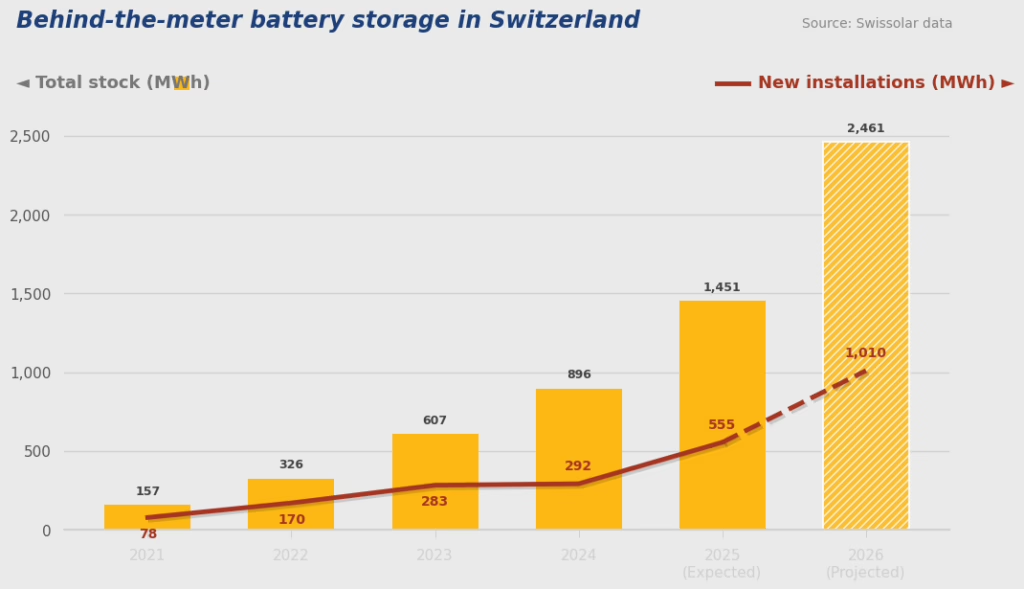
The primary driver for installation remains self-consumption optimization, cited by 95% of surveyed installers for residential customers, 80% for commercial and industrial, and 70% for agricultural customers. However, the economics have shifted notably: a 15 kWh system cost an average of CHF 8,800 in 2025, down roughly 25% from CHF 10,600 the prior year.
The mix of who is installing is also changing. While nearly 90% of new behind-the-meter systems went into single-family homes in 2023, commercial, industrial, and agricultural deployments are growing fast. Average commercial and industrial system sizes nearly tripled, from 37.5 kWh in 2023 to 96.5 kWh in 2024.
On the grid-scale side, at least 129 MW / 135 MWh of front-of-the-meter storage is already in operation, with 4.2 GWh of grid storage capacity planned by 2030. The largest project in the pipeline is a 1,200 MW/2,100 MWh redox flow system in Laufenburg, expected to be completed in 2028 in a win for that battery technology.
Swissolar puts current utility-scale installed costs at around CHF 300/kWh ($376/kWh) for projects above 5 MWh. The report notes Switzerland’s relatively high share of flexible hydropower, reducing the immediate need for utility batteries, though it also notes the permitting fragmentation across cantonal jurisdictions.
Swissolar’s key policy recommendation is for Switzerland to develop a national storage strategy with clear build-out targets and milestones through 2035 and 2050, and to push for the rollout of dynamic grid tariffs from all distribution network operators to create true financial incentives for grid-serving storage, rather than the focus on self-consumption optimization.
Written by




Popular Posts