Cornex unveils new 165 Ah sodium-ion prismatic cell for stationary energy storage

Chinese battery manufacturer Cornex New Energy has announced a range of sodium-ion battery cells, including new prismatic cells for stationary energy storage.
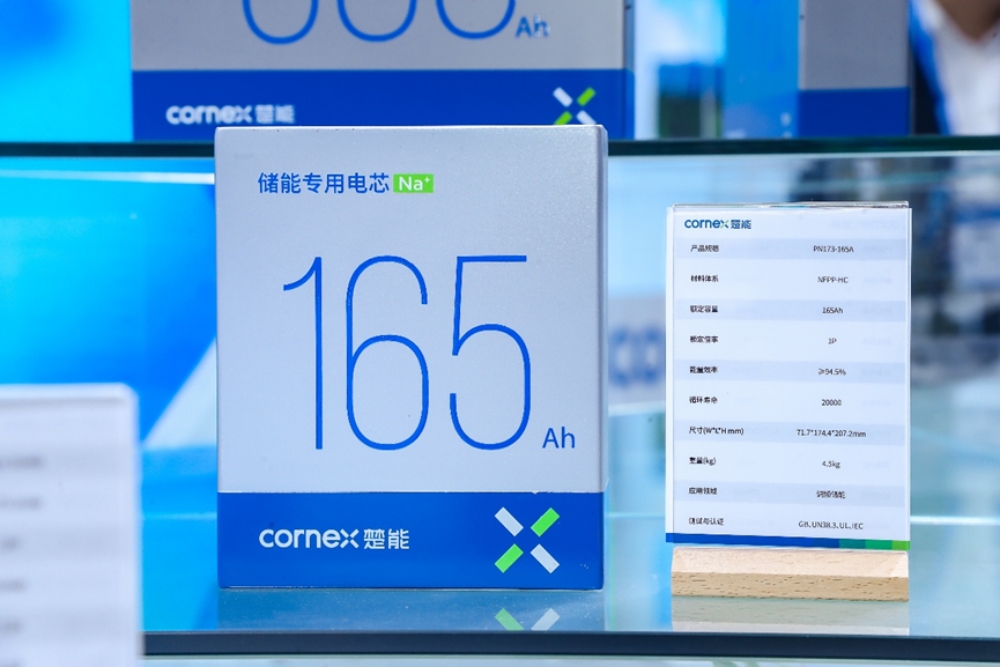
For the energy storage sector, Cornex announced that its product lineup now includes 165 Ah and 58 Ah models. The 165 Ah sodium-ion cell was highlighted for featuring a sodium iron pyrophosphate material in the cathode, with hard carbon used as the anode (polyanion-type NFPP + hard carbon). The cell, given the name PN173-165A, has obtained key certifications, including GB (Chinese national standard), UN38.3, UL, and IEC 62619.
Cornex is positioning it as “ideal for frequency regulation” with a very long cycle life – the company claims it achieves 1P energy efficiency of ≥94.5% and a cycle life exceeding 20,000 cycles. It weighs 4.5 kg and has dimensions 71.7 by 174.4 by 207.2mm.
In response to a query, Cornex said the nominal gravimetric energy density is 102 Wh/kg (0.5P), and the nominal volumetric energy density 182 Wh/L (0.5P).
In comparison with Cornex’s own LFP cells, Cornex’s 314 Ah cell weighs 5.6 kg, or around 24% more weight for 90% more energy, giving some indication of where sodium-ion limitations may be found, considering the lower density.
However, sodium-ion cells generally feature more sustainable and readily available materials, wider temperature operating ranges before derating, and improved safety over lithium-cells, including higher thermal runaway initiation temperatures. At scale, the ability to transport sodium-ion cells at zero volts may greatly lower logistics risks as well.
588 Ah cell reaches mass production
Cornex announced its 588 Ah cell back in September 2025, and said within the last week that the new cell was “officially moving to mass production”.
The 588 Ah cell delivers a range of new design features, and on the specs side, packs a gravimetric energy density of 190 Wh/kg, a volumetric energy density of 419 Wh/L, and a round-trip energy efficiency of 96.5%. Its cycle life exceeds 12,000 charge-discharge cycles.
A video detailed the innovations within the cell.
Cylindrical sodium-ion for mobility
Cornex also announced four cylindrical battery products coming to market for use as portable power or mobility, such as for small-scale e-bikes, scooters, or power tools. They are also positioned as addressing challenges in the lower-spec power sector, including “low-temperature start-up capability and severe range decay”, and the manufacturer now offers 10 Ah, 12.5 Ah, 16 Ah, and 26.5 Ah capacity cells.
In very cold and below-freezing temperatures, standard lithium-ion batteries cannot be operated or experience significant degradation. Manufacturers can include heating elements and films to maintain warmer temperatures, but this then involves self-consumption of energy, often greatly reducing efficiency.
In terms of applications, numbers are building. At the grid-scale level, Peak deployed the largest grid-scale sodium-ion storage system in the United States, though still relatively small at 3.5 MWh, with much larger projects operating in China.
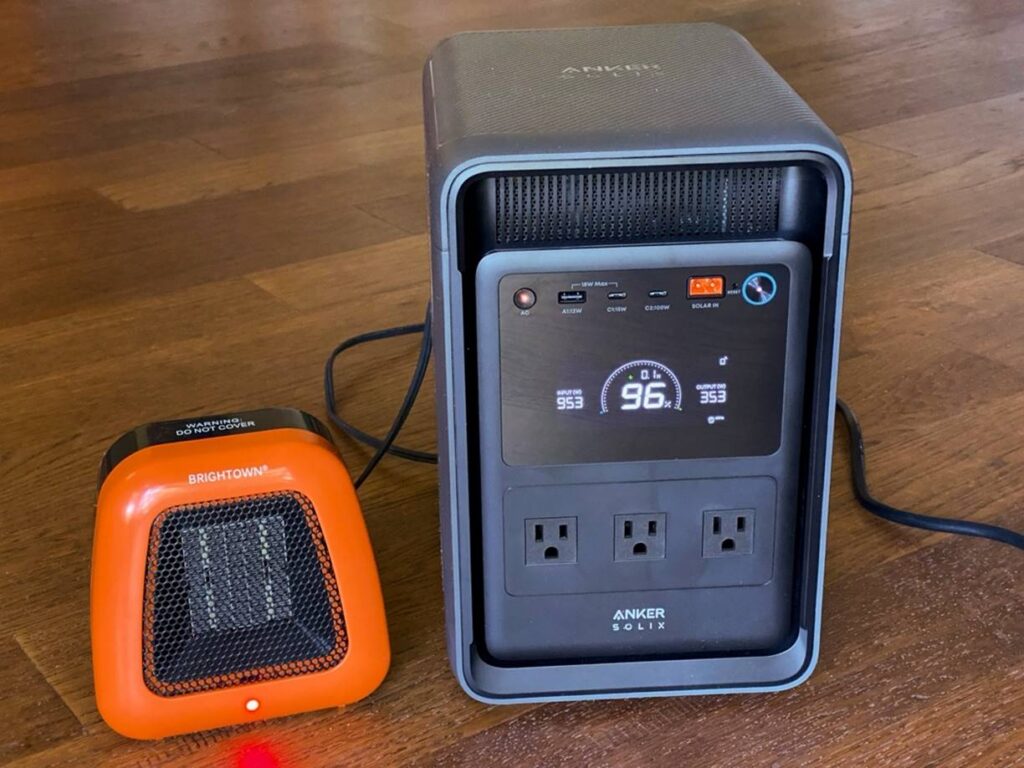
At the smaller scale, Bluetti already included sodium-ion cells in one of its portable products, the Pioneer Na, as an attempt to offer a more versatile portable power station able to function in very cold weather.
Written by



Popular Posts