Shaanxi state-owned unit rolls out 3,777 Ah LFP storage cell in China

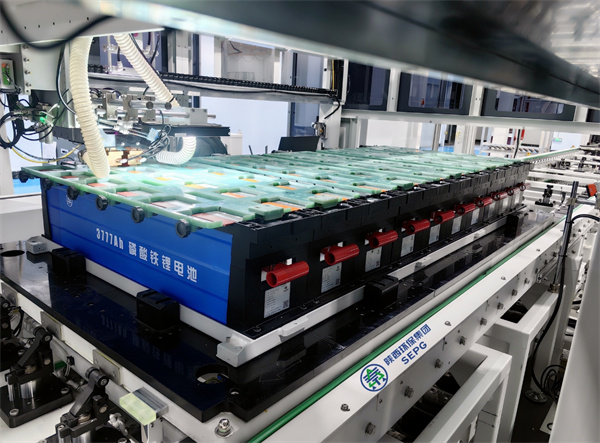
A unit under Shaanxi Environmental Protection Industry Group (SEPG) has rolled out the first batch of a 3,777 Ah lithium iron phosphate (LFP) energy storage cell at its production base in Yulin Economic and Technological Development Zone, in what Chinese media and company-linked reports describe as a new capacity benchmark for mass-produced LFP storage batteries. The launch also marks the commissioning of a 2 GWh smart manufacturing line built around the product.
The ownership structure is quite Chinese-style. The top-level parent is Shaanxi Environmental Protection Industry Group Co., Ltd., a provincial state-owned enterprise. Under it sits Shaanxi Green Energy Co., Ltd., the group’s wholly owned renewable energy platform.
The product developer and project operator, Shaanxi Green Energy Storage Technology Co., Ltd., is a wholly owned subsidiary of Shaanxi Green Energy and was established in September 2025 in Yulin to focus on investment in storage battery production lines, large-capacity cell R&D, manufacturing, and sales.
According to the disclosed specifications, the new prismatic LFP cell has a nominal capacity of 3,777 Ah, although testing reportedly showed an actual capacity of no less than 3,900 Ah. It has a nominal voltage of 3.2 V, giving single-cell energy of 12.086 kWh.
Other published parameters include more than 95% charge-discharge energy efficiency, 0.5C continuous charge/discharge capability, 12,000 cycles, and a calendar life of more than 25 years. The reported dimensions are 1,095 mm × 203 mm × 294 mm.
The company is framing the product around four main technical features: an ultra-large single-cell format, terminal liquid-cooling thermal management, an orderly thermal-runaway handling system, and a repairable cycle-life design. According to the descriptions released by the company and state media, the large-format design is intended to reduce parts count, pack-stage losses, and overall balance-of-system cost compared with conventional 280 Ah-class solutions. The thermal management system is designed to keep temperature spread within 3 C, while the safety concept aims to direct and neutralize combustible gases in the event of thermal runaway. A separate electrolyte and film-forming approach is said to slow capacity fade over long cycling.
In application terms, the company says the cell can support grid-side standalone storage, renewable energy base projects, commercial and industrial storage, and mobile emergency storage. It also intends to use the cell in products such as DC prefabricated cabins and mobile storage fast-charging vehicles, suggesting that Shaanxi is trying to build not just a cell line, but a broader storage manufacturing ecosystem in northwest China.
Written by
Comments

Popular Posts