BVES: German storage industry back on growth path

Revenue in the energy storage industry recovered significantly last year, increasing by 31 percent to €15.2 billion. This brings it nearly back to the levels seen in 2023, according to the market analysis presented on Friday by the German Energy Storage Systems Association (BVES).
For the current year, a further increase in sales revenue is expected, with a rise to between €16 billion and €19 billion possible. The analysis includes the turnover of all companies based in Germany, both domestically and abroad, as well as foreign companies operating within Germany.
A breakdown of the revenue shows that the “System Infrastructure” segment grew particularly strongly, increasing by 72 percent compared to 2024 and accounting for a good third of total sales. The “Household & Buildings” segment grew less rapidly, by 15 percent. At €7.5 billion, it accounts for nearly half of the industry’s total turnover. “Industry & Commerce” reached revenues of €1.2 billion, while the “Research & Development” sector accounted for €1.0 billion.
Looking more closely at the segments, revenue for residential PV storage was slightly down in 2025—though it remained at a high level of €2.2 billion. According to the survey, approximately 2.3 million residential storage systems with 12.5 GW of power and nearly 20 GWh of capacity were installed in Germany by the end of 2025.
Additionally, BVES recorded a rapid increase in plug-in solar storage (balcony storage). It estimates around 100,000 installed systems, though these contribute only small amounts to the total revenue. The market share of German companies in 2025 is estimated to be slightly higher than in 2024, although Asian, and particularly Chinese, providers remain dominant.
For the current year, BVES expects the number of residential storage systems sold to be around 535,000 units, similar to 2024. The increasing number of low-cost balcony storage systems could, however, cause the segment’s total revenue to fall. Revenue estimates for 2026 range between €2.1 billion and €2.5 billion.
In contrast, thermal storage systems in this segment saw gains. With 299,000 units sold, volume was about 50 percent higher than in 2024, though it fell significantly short of the record level seen in 2023, partly because prices have dropped. Revenue in this area was €5.3 billion in 2025 and is expected to rise further this year.
In the “Industry & Commerce” segment, there is increased demand for battery storage from the industrial sector. Furthermore, the accelerated expansion of charging infrastructure is driving sales in this area. Following €1.1 billion last year, BVES expects an increase to up to €1.5 billion this year. The lack of incentives for flexibility, as well as potential regulations and long approval processes, are seen as the biggest hurdles to reaching maximum sales potential.
The industry study also notes high interest in thermal storage within this market segment. These systems are slowly moving beyond pilot project status, though in 2025, actual sales mostly took place abroad. This year, however, total revenues could double or triple.
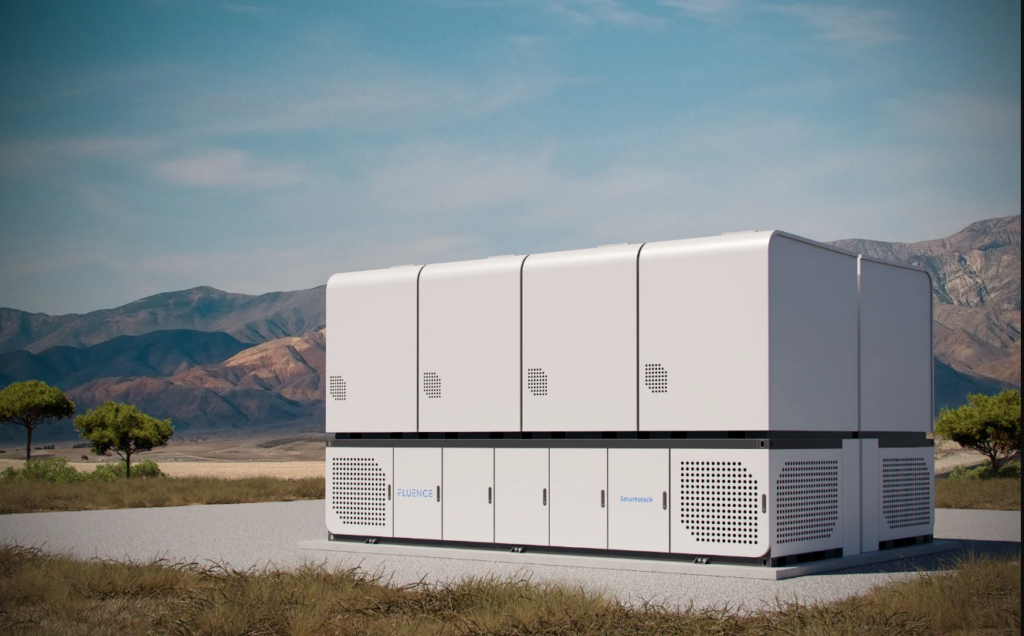
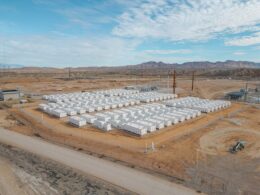
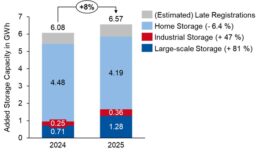
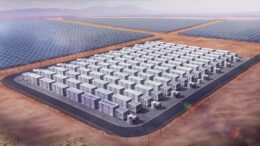
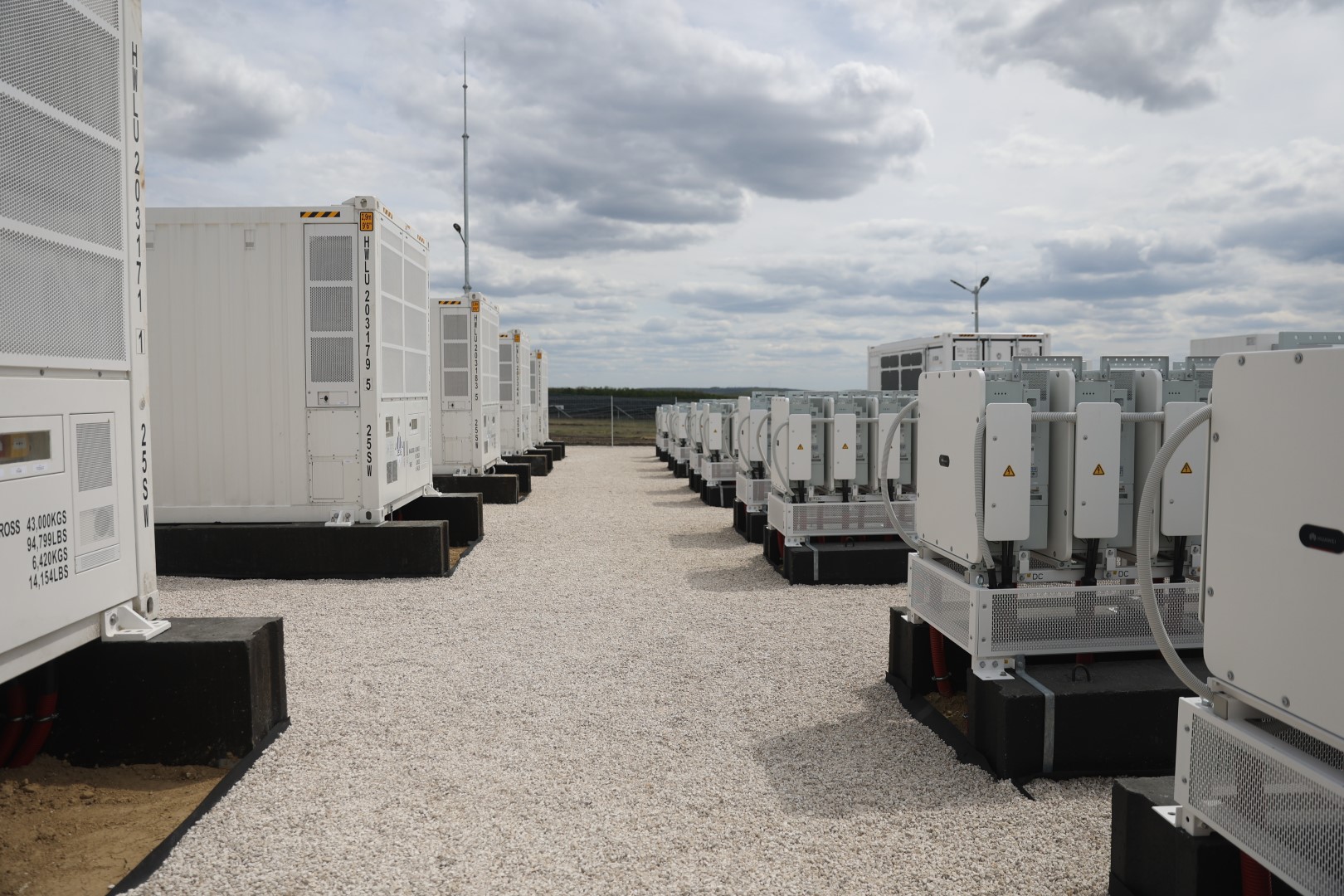
For large-scale battery storage, which falls under the “System Infrastructure” segment, revenues rose sharply in 2025 and could continue to pick up strongly this year. BVES sees a potential of up to €7.5 billion in this area, with co-location and arbitrage potential viewed as the primary drivers. According to assumptions, the power of large-scale storage installed in Germany could rise from 2.5 GW in 2025 to 5 GW by the end of the year. Capacity would more than double, from 4 GWh to 9 GWh. However, risks remain, such as the debate over grid fees and flexible grid connection agreements, which could ultimately deter investors.
The association also provided an assessment of current developments in the first quarter of 2026. Its industry survey showed that the mood is clouding over significantly and uncertainty is growing. “The decisive factor is the lack of planning certainty: investment decisions are being overturned, projects are being delayed,” the association stated. Therefore, without short-term countermeasures, a structural investment gap looms. “Germany risks a flexibility gap—not due to a lack of technology, but due to a lack of planning certainty,” BVES continued. “This can only be covered up in the short term with very expensive capacity mechanisms.”
“Battery Charts” from RWTH Aachen University re-evaluated storage additions for the first quarter after the late reporting deadlines for the systems had expired. With an estimated 2.2 GWh, a new record for battery storage additions at a quarterly level has been recorded, with large-scale storage in particular driving the market.
From pv magazine Germany.
Written by
Comments




Popular Posts