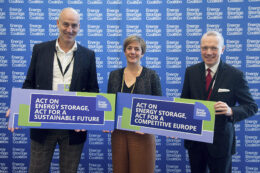
Copenhagen Energy and Akaysha Energy plan 2 GWh storage system in Germany

Copenhagen Energy and Akaysha Energy intend to implement one of the country’s largest battery storage projects in Bühl near Baden-Baden: the partners plan to build a four-hour storage system with a capacity of 500 MW. In doing so, they are following the trend of designing large-scale batteries to store electricity over several hours for a 2 GWh capacity. The companies are presenting their project to the local municipal council today.
The location is attractive because it is close to the extra-high voltage infrastructure as well as a substation. According to a statement from the municipality of Bühl, this keeps land consumption as low as possible. An industrial estate is also located in the immediate vicinity. The municipality expects the project to provide an impetus for the regional economy as well as additional trade tax revenue. In addition, it contributes to a secure and sustainable energy supply.
Transferring experience from Australia to Germany
Akaysha Energy is an Australian developer and operator of battery storage systems, while the Danish company Copenhagen Energy develops renewable energy projects and trades electricity. The two partners have formed a joint venture to build large-scale storage systems in Germany.
The partnership is backed by a corporate credit facility amounting to the equivalent of €184 million. This was provided by a consortium consisting of Deutsche Bank, BNP Paribas, ING, SMBC, and Westpac. Every German project will be funded through project-specific, non-recourse financing as well as potential regional co-investments, Paul Curnow, Managing Director and Chief Commercial Officer of Akaysha Energy, explained recently.
According to Curnow, the contractual structures that Akaysha Energy intends to deploy in Germany are based on experience in Australia. There, products such as virtual tolling models and revenue-sharing models have been the primary drivers of storage expansion. Akaysha Energy is also seeing strong demand for capacity-swap style agreements—”highly structured products where we first look at what the offtaker actually needs and what risk they can take, and then design the structure so that it remains bankable,” Curnow explains.
Akaysha Energy stated that as of March 30, 2026, it had a project pipeline of 2.6 GW in Germany. In addition to Baden-Württemberg, the projects are located in Schleswig-Holstein, Lower Saxony, Mecklenburg-Western Pomerania, and Brandenburg.
From pv magazine Germany.
Written by
Comments
Popular Posts