Sunrun, Tesla, Renew Home announce plans for 16.8 GW virtual power plant program


Sunrun, Tesla and Renew Home have announced an agreement to deliver up to 16.8 GW of flexible power output to hyperscalers and utilities. The agreement establishes a framework for the companies to work together on aggregating devices into VPPs to address the needs of large offtakers.
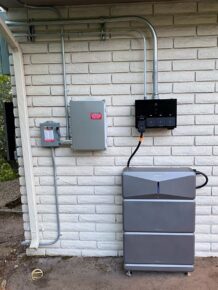
The proposed VPPs would draw dispatchable capacity from home battery systems operated by Sunrun and Tesla, alongside flexible peak capacity from more than 8 million smart thermostats and devices managed by Renew Home.
The companies say the VPPs it deploys under this framework could include as many as 12 million existing devices located at 9 million customer homes across the United States, including Alaska, Hawaii and Puerto Rico. The overall 16.8 GW of capacity would be made up of slightly more than 9 GW of smart thermostats and 7.8 GW of batteries.
The announcement describes VPP aggregations that could be deployed within months of deals being signed, requiring no additional hardware, software, interconnection, water, or land usage for offtakers.
“The stakes are clear. America’s grid faces mounting pressure from data centers, electrification, and manufacturing growth that no single infrastructure solution can solve fast enough,” said Tesla senior director of residential energy Colby Hastings in a statement. “Sunrun, Renew Home, and Tesla believe that a huge piece of the answer is already in place – in the batteries, thermostats, and electric vehicles inside millions of American homes, waiting to be put to work.”
The companies call the proposal a “win-win-win,” estimating that the VPPs could result in better grid utilization, faster speed to new capacity to meet broader system needs and lower energy bills for residential customers. In addition, they promise direct payments for those residential customers who allow their devices to participate in the programs, and say they paid more than $67 million to such households in 2025.
Available capacity
To illustrate the potential capacity in geographic terms, the companies have developed a website called the VPP capacity explorer, which allows users to see the capacity available in each state.
In total, the companies divide the available capacity into three U.S. regions. They say there is 6.2 GW in western states including Hawaii and Alaska, 4.6 GW in central states and 6 GW in eastern states (including Puerto Rico).

Detailed data available in the explorer shows that just four places in the country account for over 50% of the total available capacity: California, Texas, Puerto Rico and Florida.
California alone represents 4.66 GW (27.7%) of the total program capacity, with 1.05 GW of that capacity from HVAC and 3.61 GW from batteries, for 46% of all battery capacity in the program.
Broader market
Taken together, the 16.8 GW of combined capacity would make the Tesla/Sunrun/Renew Home VPP program the largest in the United States.
For context, the most recent Wood Mackenzie VPP report indicated the North American VPP market had a total capacity of 37.5 GW as of mid 2025, with just 10.2% of that capacity coming from residential programs.
The commercial and industrial (C&I) VPP space has several large players such Uplight, Voltus, CPower Energy and Enel North America.
Large data centers, among the target customers of the Tesla/Sunrun/Renew offering, often participate in C&I VPPs by providing flexibility through demand response, sometimes by activating on-site backup generators or battery energy storage systems to reduce their load on the grid and earn incentives.
The value offered to data center operators by the Tesla/Sunrun/Renew VPP is a quick way to account for their effect on the capacity of the grid that has the potential to be less expensive than paying for grid upgrade.
Grid capacity is a limiting factor for how many new large loads can connect to the grid, and utilities are increasingly requiring data center developers to sign specialized agreements before they will connect them to the grid.
In addition, state lawmakers and regulators are increasingly interested in requiring the developers of projects that will draw large amounts of grid power to pay for all of the costs necessary to bring their facilities online.
The POWER Act (HB 3546) in Oregon is one such law, which directed the state public utilities commission to establish a new rate class for industrial users with 20 MW or more of planned load, and required those users to sign long-term contracts with early-exit penalties to ensure they pay for the costs to serve them.
Data center power usage has also taken center stage nationally. U.S. Rep. Kathy Castor (D-FL) and Gabe Evans (R-CO) recently introduced the bipartisan Ratepayer Protection Act, which would mandate that state utility regulators establish strict rules requiring any new customer demanding 100 megawatts or more to pay for infrastructure necessary to serve them.
When faced with the prospect of paying for mandated infrastructure upgrades, paying for capacity from the Tesa/Sunrun/Renew Home VPP may seem cheap in comparison.
From pv magazine USA
More about
Written by




Popular Posts