Chile reviews 450 MW/3.6 GWh pumped hydro storage project

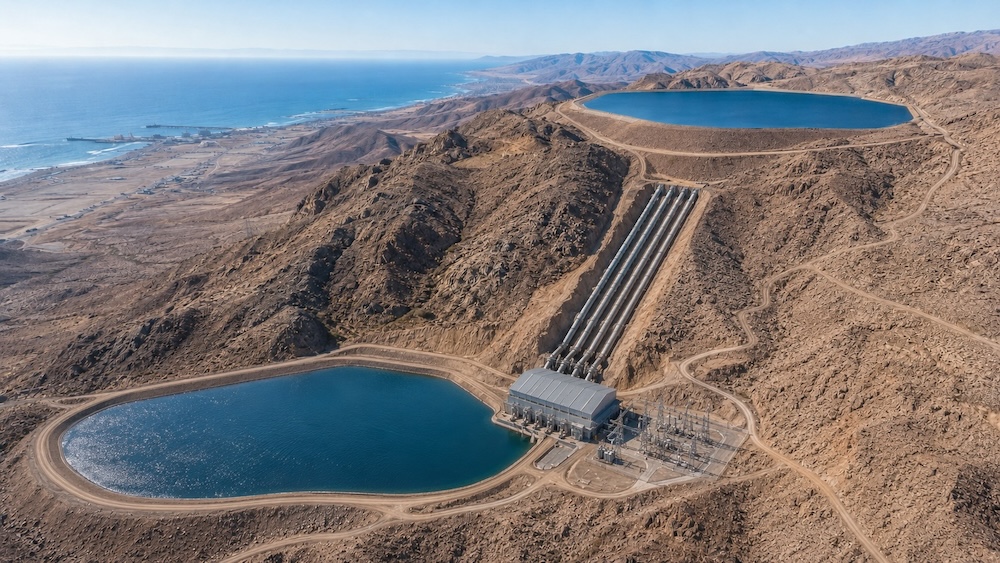
Central de Bombeo Atacama, a joint venture between Chile’s Susterra and France’s Hyvity, has submitted an environmental impact assessment for a 450 MW/3.6 GWh pumped hydro energy storage project in Chile’s Atacama region.
The proposed project, located in the municipality of Caldera, is under review through Chile’s Environmental Impact Assessment System and has not yet received environmental approval. The facility would store electricity generated from renewable sources using a reversible pumped hydro system capable of delivering its full output for eight hours.
The project includes two artificial reservoirs, each with a capacity of about 4.8 million m³, connected by pressure pipelines and a powerhouse. During periods of low electricity demand, the facility would use electricity from Chile’s National Electric System to pump water to the upper reservoir. During peak demand, the stored water would flow back through turbines to generate electricity.
The closed-loop system would use desalinated water supplied by companies already operating in the area with existing permitted pipeline infrastructure. The developer said it does not plan to extract water from natural sources and estimates it will need to replace about 1,953 m³ of water per day to offset evaporation losses.
Electricity would be exported through a step-up substation and a 220 kV double-circuit transmission line measuring 151.3 meters in length, connecting to an existing transmission line serving the Cerro Negro Norte mine and the Punta Totoralillo desalination plant.
The environmental documentation estimates the facility could generate up to 1,314 GWh of electricity annually through its discharge cycles. It notes that the plant would not produce additional primary energy but would shift renewable electricity generation to periods of higher demand.
The project carries an estimated investment of $900 million. Construction is scheduled to begin in October 2027 and continue for 53 months, with commissioning targeted for February 2032, subject to environmental and other regulatory approvals.
The environmental impact assessment identifies potential impacts on threatened or rare plant species and archaeological sites. Proposed mitigation measures include relocating cacti and geophytes, ex situ conservation of threatened species, archaeological protection and recovery, and continuous monitoring during earthworks.
The project is designed for a 45-year lifetime, with operations initially planned through 2072 before decommissioning between April 2072 and June 2073.
From pv magazine LatAm
More about
Written by
Comments




Popular Posts