UNIGRID completes Hyundai accelerator test of sodium-ion cells

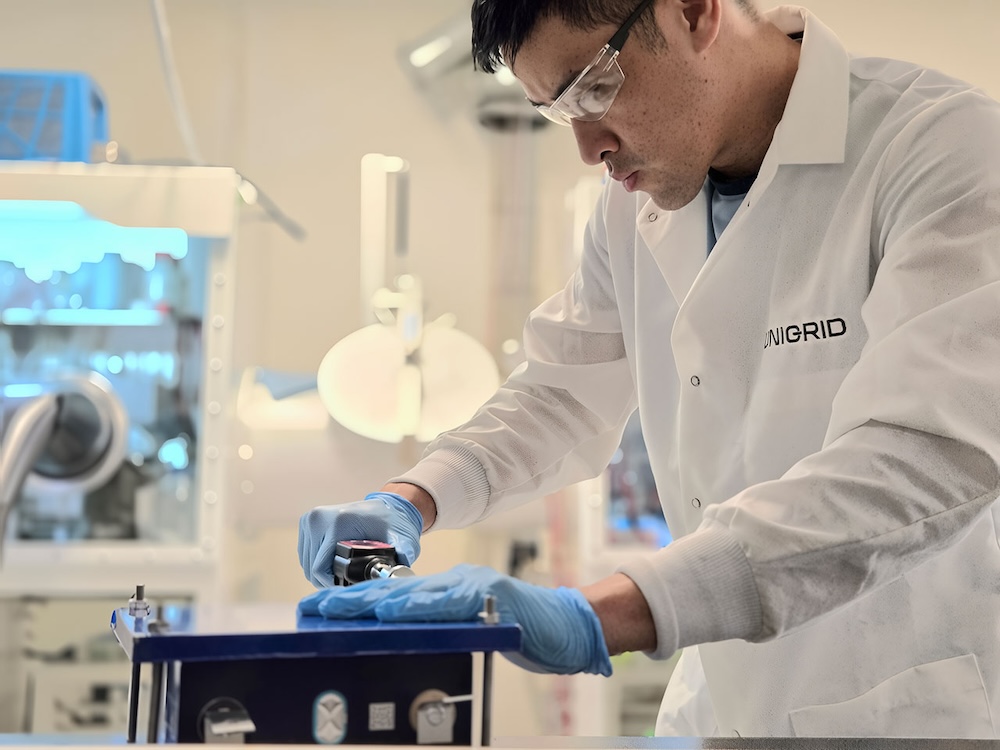
UNIGRID said it has completed Hyundai Motor Group’s ZER01NE Accelerator program, an initiative the companies said began in 2025 to identify non-flammable BESS technologies for high-safety energy infrastructure. The US battery developer’s proprietary sodium chromium oxide (NCO) chemistry was selected for advanced testing under the program, according to the company.
UNIGRID said its NCO cells passed safety abuse tests without fire or thermal propagation, and it reported minimal capacity degradation under sustained cycling at full depth of discharge. The company also said the cells demonstrated operation across a thermal range of -20 to 60 degrees Celsius.
Independent research on sodium chromium oxide cathodes supports the material as a promising, thermally stable option among sodium-ion chemistries, with several studies reporting no significant exothermic reaction below roughly 250 C in partially desodiated samples.
However, cycle life in that research is highly dependent on formulation and operating conditions rather than an inherent property of the base chemistry, and the academic literature does not substantiate UNIGRID’s specific product-level performance claims independently.
UNIGRID CEO Darren H. S. Tan said the validation confirms the company’s NCO technology addresses the safety and longevity requirements needed to deploy sodium-ion batteries for grid energy applications. UNIGRID has previously said its contract-manufacturing, “fabless” model allows it to scale without the capital burden of building its own factory, and Tan has said policy unpredictability around tariffs and Foreign Entity of Concern (FEOC) rules poses a bigger threat to US battery supply chains than tariff rates themselves.
Hyundai Green Factory Development Team Senior Manager Jongguk Bae said UNIGRID’s validation results position its chemistry to meet the safety and performance standards required for the group’s upcoming energy initiatives.
Hyundai said it will work with South Korean integration partners to jointly develop a sodium-ion BESS system using UNIGRID’s technology, with the resulting platforms intended to serve as distributed energy resources at the group’s global production facilities.
UNIGRID, founded in 2021 as a University of California, San Diego spinout, said in January 2026 that it had begun commercial-volume international shipments of its NCO cells after obtaining UN38.3 transport certification. The company announced first deliveries of its Na+Casa residential energy storage system in July 2026, with initial installations in Europe and US installations expected by the end of the year pending additional compliance requirements. In August 2026, UNIGRID and Syntropic Power announced a partnership targeting 1 GWh of North American sodium-ion deployments beginning in 2027.
UNIGRID’s validation announcement follows a string of sodium-ion developments this year. CATL has outlined cold-weather specifications and a delivery timeline for its TENER Sodium system, while Peak Energy is building a 4 GWh grid-scale sodium-ion factory in California. In Europe, Austrian manufacturer Salzstrom recently landed its first commercial sodium-ion order in Germany, and the industry more broadly continues to debate which cathode chemistry will lead the sodium-ion market.
More about
Written by
Popular Posts