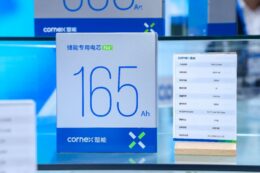
Clarifying the CATL Tener Sodium, with new specifications and availability

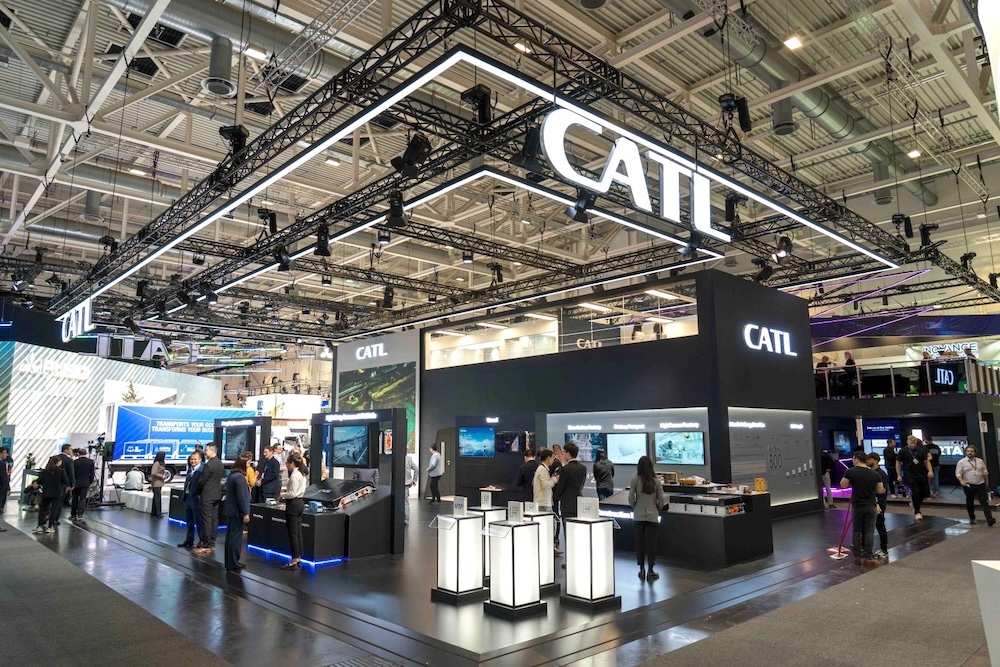
CATL’s Tener Sodium battery energy storage system (BESS) is one of the most anticipated new products on the market, as markets watch for the great hope to compete with lithium-ion products across a number of potential scenarios.
The Tener Sodium product launched at The Smarter E event 2026 in Munich in June, and at the time, the company gave a capacity of more than 30 MWh per block.
With further details scarce, a Oct. 29 ATA Insights webinar hosted CATL energy storage product solution manager David Santiago showed specficiations and datasheets across the BESS and in-house PCS to detail how the four-hour system comes together.
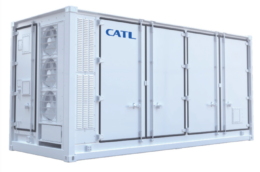
The system is built in pairs, with two, four, six or eight cabinets available to spec. The full block sits in two back-to-back rows of four and measures 18.2 m across, 7 m deep and 3.5 m high.
Santiago put each cabinet at around 15 feet long and 44 to 45 metric tons. That works out to about 4 MWh per cabinet in the eight-cabinet version.
At launch, CATL had put the module weight at about 42 metric tons. CATL also plans to use the same cabinets and layout for a lithium iron phosphate (LFP) version. Santiago put that version at around 50 MWh across eight cabinets and said developers could choose the chemistry during project design. CATL is prioritizing sodium-ion certification, with the LFP version to follow.
Tener Sodium: Core battery specs
The provided system specifications lists a rated energy of 30+ MWh, with a charge and discharge rate of up to 0.25P, or a power output of 7.5 MW for four hours. (Santiago didn’t specify a power output change if the block has a final capacity of 32 MWh)
The battery is rated at 1,166.88 V DC, with a voltage range of 612 V to 1,387.2 V. CATL specifies 95% round-trip efficiency at 25°C and 0.25P, and 70% state of health after 20 years under a 0.25P duty cycle marked “1cls” on the slide.
The liquid-cooled battery operates from −35°C to +55°C and can be stored from −35°C to +60°C. CATL lists noise at 65 dB(A) or less, IP55 ingress protection, C5 corrosion protection with C4 optional, and operation up to 4,000 m without derating. Communications include CAN, Modbus TCP/IP and RS485.
At launch, CATL reported 15,000 cycles at 25°C and more than 10,000 at 45°C, as well as more than 92% capacity retention at −20°C. The liquid-cooled battery operates from −35°C to +55°C. It is rated IP55, with operation up to 4,000 m without derating.
PCS: CATL’s own in-house Terapower 265 kW converter
CATL uses bidirectional DC/DC conversion to boost voltage at the low end of the battery’s range. The Terapower module shown in the webinar combines that DC/DC stage with a power conversion system (PCS). CATL offers its own PCS though it can also work with other manufacturers.
It takes 600 V to 1,500 V DC at up to 222 A and is rated at 265 kW, with a 690 V AC output at 50 or 60 Hz. CATL lists peak efficiency of at least 99.2%, full-load efficiency of at least 98.5% and current harmonic distortion below 3% at rated load.
The converter is liquid-cooled and rated IP66, with an operating range of −40°C to +60°C and a maximum altitude of 5,000 m. It starts to derate above 50°C and above 3,000 m. It lists RS485, Ethernet and CAN interfaces and support for IEC 61850 and Modbus TCP.
Santiago said the PCS ties into the battery’s thermal management system and is accounted for in its auxiliary consumption.
Tener Sodium cooling, auxiliary power, cycling vs CATL’s LFP EnerX
Against its EnerX 0.25P LFP system, CATL says the sodium-ion cells generate 27.2% less heat per unit of energy at the beginning of life and 32.7% less at end of life.
For a 50 MWh station, it puts DC-side refrigeration capacity at 490 kW, down from 720 kW for EnerX. It lists noise at 65 dB(A) versus 75 dB(A) and puts the share of power used by auxiliaries 10% lower. At launch, CATL separately put Tener Sodium’s auxiliary consumption at 1%, against what it called a 2% industry average.
The spec sheet lists 95% round-trip efficiency at 25°C and 0.25P and 70% state of health after 20 years at one cycle per day. The webinar’s degradation curves put capacity retention at 71.3% after 20 years at one cycle per day and 65.2% after 19 years at two cycles per day. Santiago described those curves as older estimates and said CATL had since obtained “better” data as the product matures.
Cost savings and footprint
For a 500 MWh project, CATL modeled 16 Tener Sodium blocks against 23 EnerX blocks. The sodium layout covered 6,630 m², compared with about 9,700 m² for EnerX, a reduction of roughly 32%.
In CATL’s comparison, a Tener Sodium block takes up 158.5 m², against 180.6 m² for an EnerX 0.25P LFP block. The slide lists an areal density of 0.197 MWh/m² for Tener Sodium and 0.125 MWh/m² for EnerX.
In terms of cost savings overall in this scenario, CATL estimated 9.2% lower engineering, procurement and construction costs for the sodium layout.
Of that breakdown, EPC equipment costs fell 12%, civil works excluding labor fell 16%, and labor fell 17% in the model. CATL used the same design and management fees for both layouts. The fine print notes the estimate excludes transport, the substation and what CATL labels “DC/AC side” costs. In addition, CATL has several other LFP-based products, including its Tener Stack, that likely competes far better with the Tener Sodium.
Freight
Referring again to the presentation, the eight module Tener Sodium block again measures to be 18.2 m across, 7 m deep and 3.5 m high. Santiago noted, however, each sodium cabinet was said to be “15ft” in size. However, at 3.5 m high, this would exceed the height of a standard high-cube shipping container.
Availability
While already being delivered in China, CATL gave an overseas delivery window in the webinar for summer 2027, after the August 2027 production window, though the shipping method and cost remain open.
Santiago noted CATL is receiving “a lot of orders.”
Written by
Comments


Popular Posts