Record wave of grid-forming batteries progressing in Australia


With the latest figures published by the Australian Energy Market Operator (AEMO) indicating early-stage batteries are a key feature of a record surge in renewables installations, the federal body has highlighted the deployment of grid-forming batteries as a key priority for 2026.
Grid forming batteries can perform a “synthetic” version of the inertia typically offered by spinning turbines in conventional power stations. Inertia refers to the period of time such turbines take to come to a complete halt, a window during which grid operators can bring alternative power sources online in the event of unexpected halts in generation.
AEMO’s Engineering Roadmap FY2026 Priority Actions report included the use of grid-forming battery technology as one of its 29 priorities for next year and Executive General Manager for System Design Merryn York said, “A key priority over the next 12 months will involve advancing understanding of future technology capabilities, including grid-forming batteries to support power system security.”
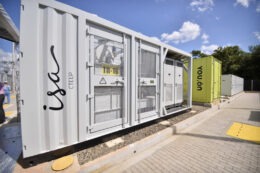
Australia’s National Electricity Market (NEM) grid already hosts seven grid-forming batteries and AEMO’s Connection Scorecard report for June indicated another 78 are in the development pipeline, and will bring a total new capacity of 15.6 GW.
AEMO’s priority actions report noted the federal body had already issued technical guidance on grid forming batteries, in line with its 2025 priorities, including the synthetic inertia contribution such facilities offer to strengthen grids. That guidance was part financed by an 18-month, AUD 15 million ($9.78 million) grant from the Australian Renewable Energy Agency to the end of June.
The annual priority actions reports by AEMO aim to raise the penetration of renewable energy and energy storage into the national electricity market (NEM) grid and Western Australia’s South West Interconnected System (SWIS) network. The government body noted the NEM grid saw a peak of 75.6% clean energy in 2024 and the SWIS network peaked at 85.1%.
AEMO’s latest Connection Scorecard reported a surge in clean energy projects in the national development pipeline, with large-scale batteries and solar-plus-storage sites notable and batteries dominating the projects in early stages of development.
Projects in the pipeline include the 200 MW/400 MWh Greenbank battery project, in Queensland, and the 185 MW/370 MWh Koorangie and 100 MW/200 MWh Latrobe Valley big batteries in Victoria.
The energy storage contribution reported was part of a total clean energy pipeline which showed 60 projects with 15.7 GW of capacity secured NEM approval in the 12 months to June. That marked a 39% increase in capacity compared to June 2024 and was the equivalent of almost 80% of the current capacity of the NEM grid.
York said 7 GW of those projects have been commissioned and are producing at full capacity.
Another 37 projects, totalling 9 GW, have registered for NEM approval in the past 12 months, up from 2.5 GW at the same point last year, and a record number of generation and storage assets have reached full output.
“Pleasingly, 29 projects, totalling 4.4 GW of capacity, reached full output this year, double last year’s total,” said York, adding 10 projects, with 1.5 GW of capacity, reached full operation in the second quarter alone.
AEMO chief executive Daniel Westerman said, “It’s a record wave of renewable generation and storage that’s progressing through the grid connection process at a scale that is much larger than we’ve seen before.”
From pv magazine Australia.
Written by





Popular Posts