No extremes, except one: Battery trading in a surprisingly steady November

After October’s structural market change with the shift to quarter-hourly day-ahead trading, November unfolded with more tempered dynamics. Short-term volatility softened, price spreads narrowed, and activation signals from balancing markets eased. However, despite the calmer surface, targeted opportunities remained for storage operators who could dynamically reallocate capacity across spot and ancillary markets.
November in Numbers
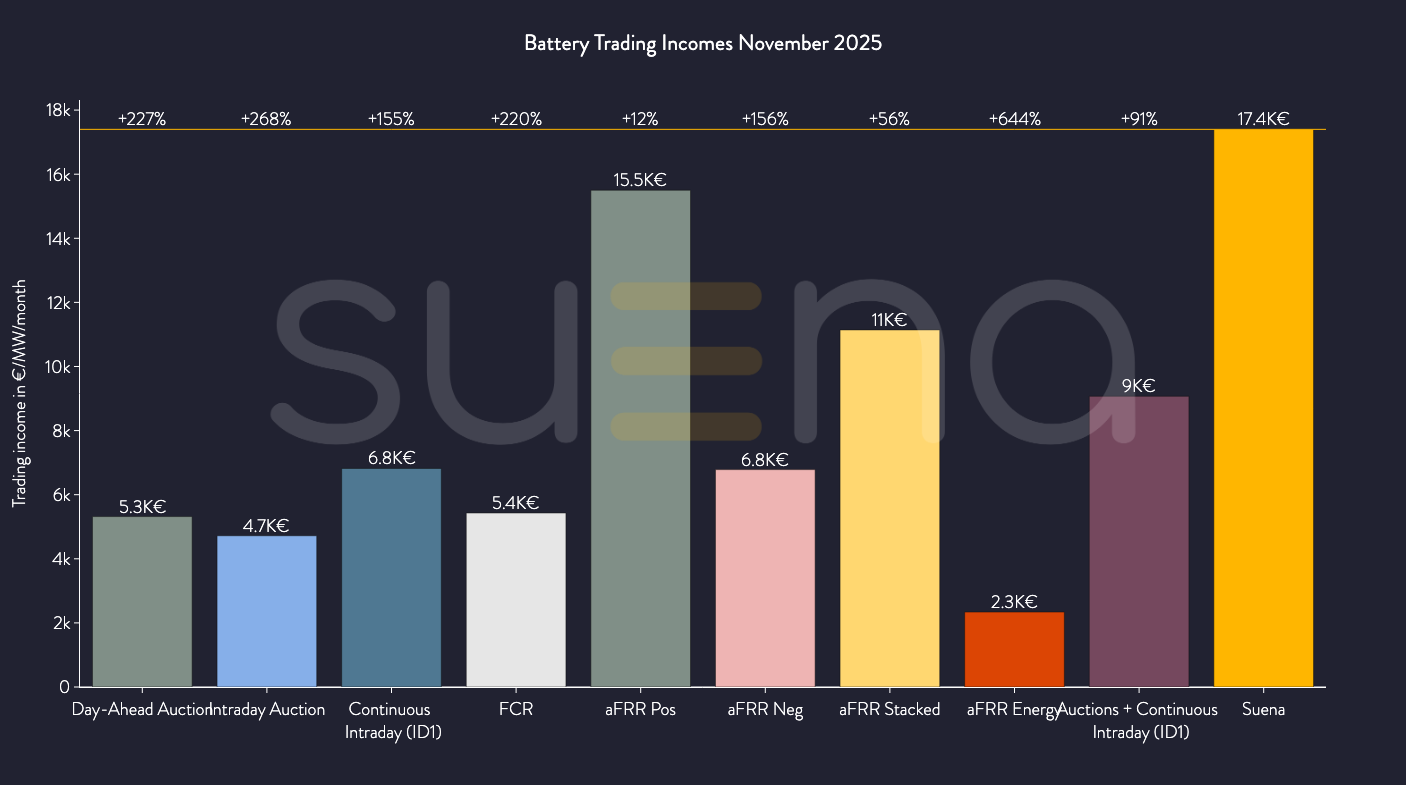
suena energy’s benchmark simulation for November shows how this played out: isolated spot market strategies returned between €4.7k and €6.8k per MW across the day-ahead and intraday markets.
FCR reached up to €5.4k per MW, while aFRR capacity prices ranged widely: from €6.8k per MW for downward reserve to €15.5k per MW for stacked capacity bids. On the energy side, aFRR activation revenues remained muted, with the Picasso benchmark landing at only €2.3k per MW.
In this more moderate environment, our Energy Trading Autopilot still achieved strong performance. With €17.4k per MW in simulated revenues, it outperformed the spot market benchmark by 56–268%, ancillary services by 12–220%, and the aFRR energy benchmark by 644% – underscoring the resilience of multi-layered trading strategies even in lower-volatility conditions.
Behind the softening
November brought a noticeable easing in price extremes across Germany’s electricity markets. For the first time since February, the system recorded no negative price hours. Average day-ahead prices climbed to just above €100/MWh, with intraday markets following a similarly steady path. Although brief spikes did occur – most notably during a minor Dunkelflaute on November 25th, when day-ahead prices surged to €230/MWh – the broader picture was one of reduced volatility and narrower spreads.
The reasons behind this shift were primarily seasonal. Wind generation returned to average autumn levels, while solar feed-in, although a bit higher then usually around this time of the year, continued its predictable decline. On the demand side, colder weather and increasing electric heating demand contributed to higher year-on-year consumption.
The easing in volatility not only dampened arbitrage potential but also pointed to a reduced need for short-term balancing interventions. In parallel, more moderate spot and intraday prices helped lower the opportunity costs of providing short-term flexibility, as providers faced fewer high-price activation scenarios to weigh against standing reserve commitments.
A more subtle playing field
The result: a market that was easier to balance, but harder to profit from. Instead of deep price troughs or wide reserve spreads, value in November emerged in short-lived windows and subtle signals. Like in slower summer months, success hinged once more on executing consistent, cross-market optimization.
In this context, systems that could dynamically reallocate between energy and capacity markets fared best. Static strategies were more likely to underperform, especially if overly reliant on specific market segments. The record-low revenue potential of just €2.3k per MW in the aFRR energy market, and the corresponding 644% outperformance of suena’s multi-market strategy, makes the value of flexible, cross-market optimization – also in quieter months – particularly evident.
Hence, for operators able to shift capacity across trading layers and products, November was about making the most out of muted and less generous market conditions.
Holy Night, Silent December?
As winter gets into full swing, December is expected to bring stronger load fundamentals, particularly in the first half of the month, when industrial activity remains high and heating demand rises with falling temperatures. Toward the holiday period, however, overall consumption may dip slightly as factories shut down and commercial usage tapers off, temporarily flattening price signals.
Still, last year’s market dynamics show how quickly these patterns can shift. In December 2024, a well-timed Dunkelflaute on the 11th triggered the highest continuous intraday revenue potential in months. Battery systems that had reserved capacity for such events saw significant upside: suena’s multi-market strategy reached €25.1k per MW – outperforming single-asset benchmarks by up to 391%.
If this year unfolds in similar fashion, December could offer a meaningful rebound from November’s more subdued environment. But as November illustrates once more, strong outcomes don’t hinge solely on moments of scarcity. Whether the landscape is opportunity-rich or muted, it’s the consistent and strategic coordination across layers that ultimately sets performance apart. In that sense, multi-market optimization remains the key lever, not just for seizing peaks, but for turning every condition into opportunity.
About the author:
Dr Lennard Wilkening is co-founder & CEO of suena energy, a green energy marketer for battery storage and renewables. suena offers marketing solutions that enable profit-maximizing multi-market trading and implement them through powerful trading algorithms. Lennard holds a PhD in grid-oriented use of battery storage systems from the Technical University of Hamburg and has more than nine years of experience in battery storage optimization and energy trading.
Written by