China completes first full-scale underwater pumped storage trial at 65 meters depth

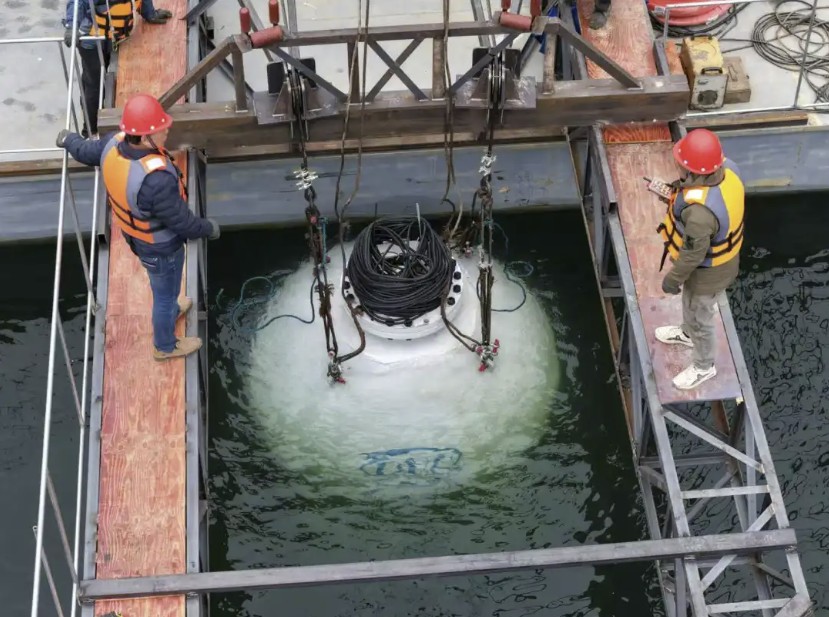
The Dongfang Research Institute, a subsidiary of China Dongfang Electric Corporation (DEC) announced the completion of a 10-day full-condition underwater trial of China’s first kilowatt-scale submerged pumped storage energy system, marking a step forward in the country’s development of alternative long-duration storage technologies.
The system, branded “Dongchu No. 1,” was tested in Minhu Lake in Sanming, Fujian province, at a water depth of 65 meters. The institute said the trial ran from Jan. 2 to Jan. 11 and included more than 100 charge and discharge cycles under continuous submerged operation.
According to DEC, the test verified the system’s structural sealing, pressure control, mechanical durability, and bidirectional energy conversion performance in a real underwater environment. The company did not disclose specific roundtrip efficiency figures, power ratings beyond the kilowatt-class designation, or detailed cost data.
The system is based on an underwater pumped storage concept that replaces conventional upper and lower reservoirs with a sealed, pressure-resistant hollow sphere deployed on the lakebed or seabed. The surrounding water body serves as the “upper reservoir,” while the interior of the sphere functions as the “lower reservoir.”
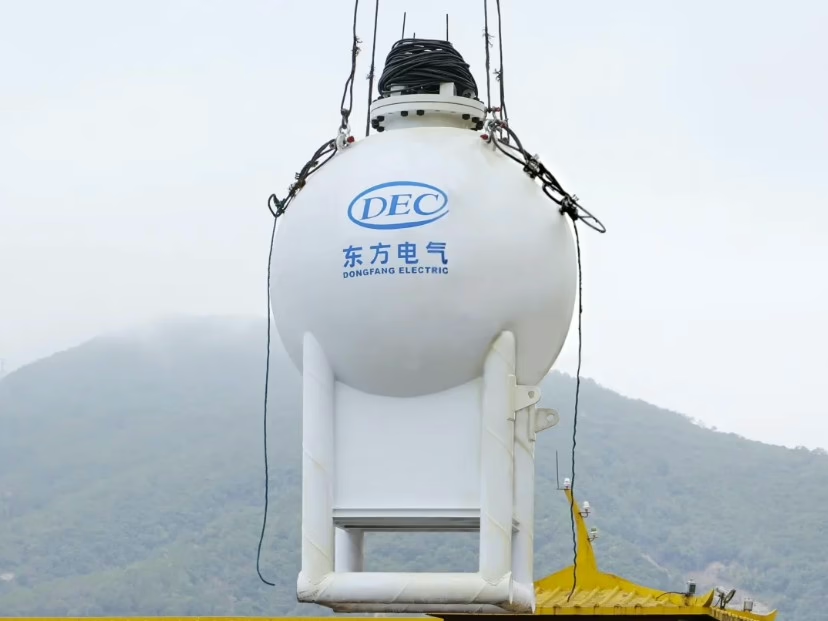
During the charging phase, electricity is used to drive a pump that expels water from inside the sphere, creating a low-pressure or near-vacuum condition. When energy is needed, a valve is opened and external water rushes back into the sphere under hydrostatic pressure, driving a turbine-generator unit to produce electricity.
At a depth of 65 meters, the system operates under approximately 6.5 bars of ambient pressure. DEC said the trial demonstrated stable pressure management and reliable switching between pumping and generation modes using a compact, integrated pump-turbine assembly.
The prototype integrates a sealed pressure vessel, a bidirectional pump-turbine and generator unit, power conversion and control electronics, underwater monitoring and communication systems, and a subsea anchoring structure. The institute said sensors tracked parameters such as pressure, temperature, and sealing integrity throughout the trial.
Internationally, similar concepts are being explored at a larger scale. Germany’s Fraunhofer Institute is leading the StEnSea project, which uses concrete hollow spheres designed for deployment at depths of 600 meters or more, while Italy-based Sizable Energy is developing modular offshore pumped storage systems. Most of these projects remain at the modeling or small-scale marine test stage, with a focus on future megawatt-scale deployment.
DEC said “Dongchu No. 1” represents China’s first kilowatt-class system to complete a full-condition underwater trial in a natural water body, moving the technology beyond laboratory testing toward early-stage engineering validation.
The company positioned the technology as a potential long-duration storage option for offshore wind farms, island microgrids, and remote marine or freshwater locations where conventional pumped storage is not feasible due to terrain constraints.
DEC added that the next development phase will focus on scaling the system toward higher power ratings and conducting trials in deeper and more complex marine environments. It has not released a timeline for megawatt-scale prototypes or commercial deployment.
The project is supported by state-owned shareholders, including Shanghai Alliance Investment and Shanghai Electric, which holds a minority stake in the institute. The company said this backing enables continued development of underwater energy storage as part of broader efforts to diversify China’s long-duration storage technology portfolio.
More about
Written by





Popular Posts