Salzstrom lands first commercial sodium-ion battery order in Germany

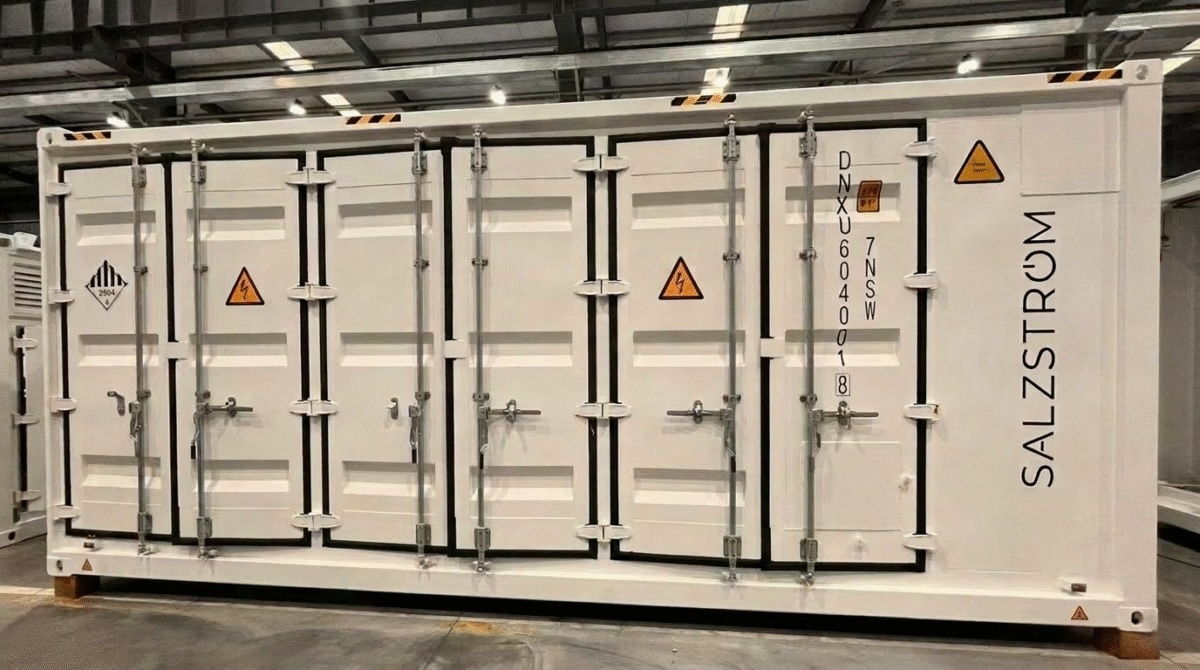
Austrian battery manufacturer Salzstrom has secured its first commercial-scale order for its sodium iron phosphate (NFPP) battery energy storage technology, marking the start of commercial production.
The company will deliver three battery containers to German research and development company Isel-automation in the third quarter of 2026. Together, the systems will provide around 7 MWh of storage capacity, with each container rated at 2.3 MWh.
The order is valued in the seven-figure euro range, according to Salzstrom.
The storage systems will be installed at three Isel-automation industrial sites in Germany, each of which is already equipped with around 500 kW of solar capacity. The batteries will have a combined power rating of 1.25 MW, with specifications varying slightly between sites.
Salzstrom said it will manage key aspects of project delivery, including system design, component selection, integration of power conversion systems (PCS) and energy management systems (EMS), commissioning and long-term operation.
The company described the project as the first deployment of commercial sodium iron phosphate battery containers in Europe and said it aims to scale the technology across the European market.
According to Salzstrom, the batteries use non-flammable cells and can operate across a wide temperature range. The company said the cells can discharge at temperatures as low as -40 C, reducing heating and cooling requirements and lowering operating costs.
Salzstrom also said the technology is well suited to high-power applications such as peak shaving, claiming it experiences less degradation under high-current operation than lithium iron phosphate (LFP) batteries.
The company is targeting industrial and commercial energy users seeking to reduce electricity costs, increase solar self-consumption and optimize grid connection capacity.
More about
Written by
Comments


Popular Posts