Spotlight on New Zealand: Battery storage capacity expands as hydro faces climate challenges


New Zealand’s electricity system remains heavily dependent on hydro generation, especially in the South Island, where facilities like Manapouri and Clyde dams dominate. Recent dry conditions in 2023 and 2024 exposed the limitations of this reliance, triggering price volatility and renewed interest in battery energy storage as a tool to increase grid flexibility and resilience.
Transpower New Zealand is the state-owned grid operator responsible for the maintenance and transmission of the electric power grid in New Zealand. Transpower publishes monthly reports on the country’s Energy Security Outlook, along with weekly market reports, with a significant focus on hydro inflows and hydro generation, such is the state of play in the country.
Utility-scale battery projects in the mix
New Zealand commissioned its first grid-scale battery near Huntly in late 2023, a 35 MW / 35 MWh lithium-ion system developed by WEL Networks and Infratec for frequency response and peak management that eventually commenced grid operations in 2024. Since then, Meridian Energy’s 100 MW / 200 MWh Ruakākā battery came online in early 2025. Positioned 130 kilometers north of Auckland, it supports load balancing on a constrained North Island grid.
Genesis Energy’s 100 MW / 200 MWh battery at Huntly is expected by 2026, targeting peak shifting and integration of variable renewables. Contact Energy’s 100 MW BESS at Glenbrook is also being built for 2026, while Australian developer Eku Energy’s proposed 300 MW battery in Waikato also signals increased investor confidence.
So far, these projects are concentrated in the North Island, where fossil fuel backup remains necessary. The South Island continues to depend on hydro and exports surplus power via the HVDC link.
Transpower currently has 6 GW of enquiries for combined utility-scale solar generation and battery energy storage systems (BESS). This is up from 2.3 GW in January 2023. The projects, as mentioned earlier, are most of those in the 500 MW+ delivery stage.
Challenges and Opportunities
Batteries, especially modern types that can offer grid-forming services, offer the same advantages as anywhere else in the world: they improve grid flexibility, deliver fast frequency response, and enable consumer participation. Their value will increase if extended dry periods persist in the “Land of the long white cloud,” or if demand patterns shift.
More so, New Zealand presents challenges for battery developers. Besides common issues like high capital costs, limited arbitrage exists due to the relatively flat load profile. Grid codes and tariffs are still evolving to accommodate two-way power flows. Planning and consenting processes are relatively well defined, but remain a factor to consider.
A massive change could come if an audacious plan for ‘Taslink,’ a 2-3GW HVDC submarine cable extending 2,600km across the Tasman Sea to facilitate the trade of electricity between Australia and NZ, were to be built. A first cost estimate was for $6.7 billion, and the most hopeful timing estables were for construction to start in 2028 should funding be secured.
Policy and markets
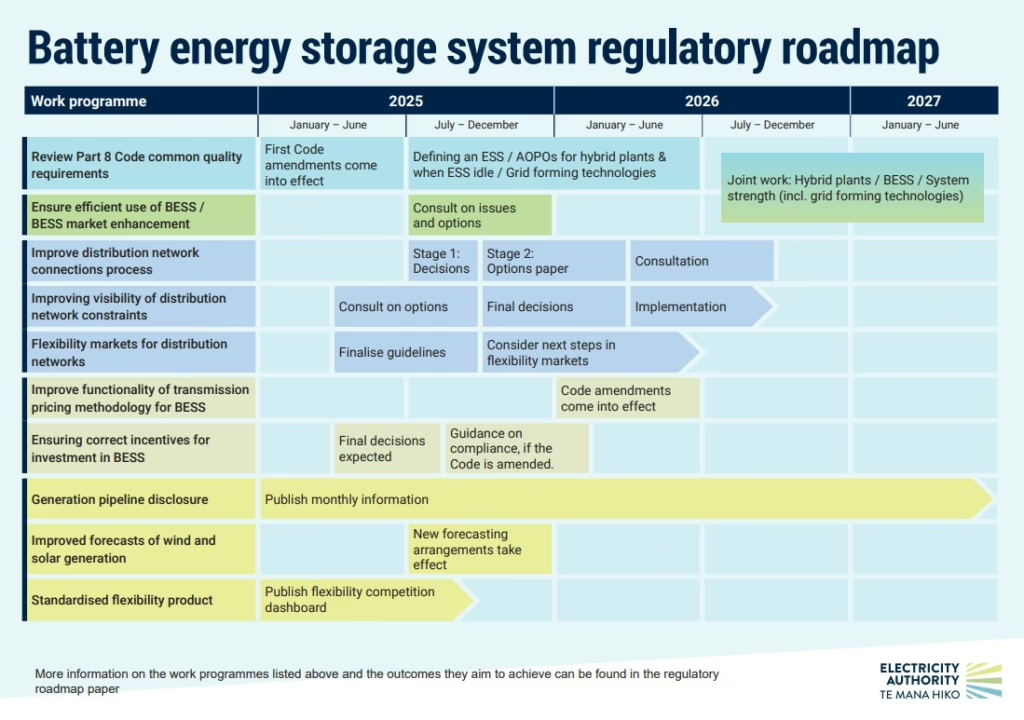
Regulatory frameworks are evolving to better integrate storage. The country’s Electricity Authority updated market rules in 2025 to enable batteries’ full participation in ancillary and reserve services, and clarified storage classification during charge and discharge cycles to improve market signals. At the same time, unlike some international markets, New Zealand offers no direct hardware subsidies.
The Ministry of Business, Innovation and Employment (MBIE) has previously underscored the critical role of battery energy storage in enhancing New Zealand’s energy resilience. In its 2024 “New Zealand Energy Outlook and Storage Strategy,” MBIE highlighted the increasing volatility in hydro generation due to climate variability and the growing need for flexible, dispatchable resources to complement renewable energy sources. The strategy acknowledges that while hydro remains a cornerstone of the national grid, its susceptibility to extended dry periods necessitates a diversified approach to energy storage and generation.
MBIE’s outlook emphasizes integrating various storage technologies, including grid-scale batteries, pumped hydro, and emerging solutions, to maintain a stable electricity supply. The strategy calls for regulatory frameworks that facilitate deployment and market participation of storage assets, ensuring they contribute effectively to grid stability.
Furthermore, MBIE stresses coordinated planning between generation, storage, and transmission infrastructure to optimise renewable resource use and meet evolving electricity system demands. This approach supports the government’s goals of achieving 100% renewable electricity generation by 2030 and reducing emissions economy-wide.
The first stage of the amended procurement plan by the Electricity Authority came into force this week, on 7 August 2025, bringing the aforementioned changes to the market, with a host more to come, as shown by the roadmap:
Written by




Popular Posts