Indiana county board unanimously rejects 800 MWh Kingfisher battery project

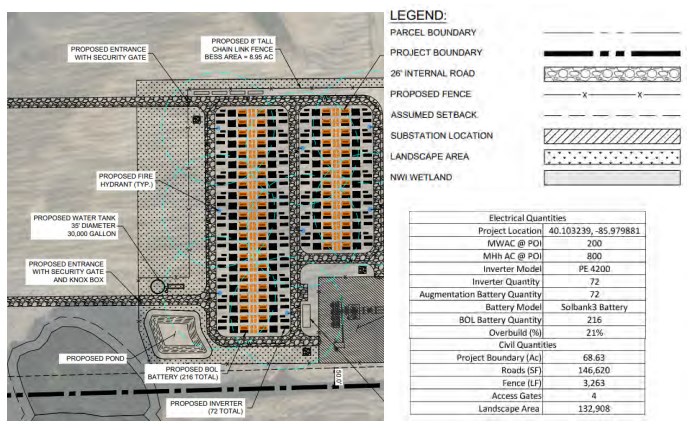
The Hamilton County Board of Zoning Appeals (BZA) in Indiana has unanimously rejected Aypa Power’s Kingfisher Reserve BESS project. The decision, made on July 23, 2025, denied a land use variance for the 200 MWac / 800 MWh standalone facility planned for a 70.01-acre agricultural parcel at 21598 Overdorf Road, Noblesville, which is currently zoned A-2 Agriculture.
Aypa Power, a Blackstone-owned company, through its lead developer, Mr. Brandon Gahman, asserted the project was crucial for addressing increased energy demand in Hamilton County. A 437-page document was prepared to give details to the project, with Gahman reportedly explaining that the estimated $200 million capital investment required thorough detailing.
Aypa Power explained that the increased energy demand is driven in part by significant data center growth, with more than 20 either under construction or proposed in Indiana. Data centers alone are projected to consume more electricity than all homes in the US state of Indiana by 2030.
Aypa highlighted a projected energy shortfall in the Midcontinent Independent System Operator (MISO) territory, which includes Indiana. MISO’s February 2024 report, “MISO’s Response to the Reliability Imperative,” forecast a 32% power shortage by 2040, potentially leading to rolling blackouts of “three to four hours, 13 to 26 days a year”.
MISO described the energy situation as a “hyper-complex risk environment”, noting that Indiana (MISO Zone 6) accounts for approximately 25% of the projected shortfall.
Aypa Power’s BESS was intended to store power from various sources for deployment during periods of high consumption to bolster grid reliability. Aypa also cited economic contributions, including over 200 local construction jobs for 9-12 months and significant new tax revenue from an estimated $200 million capital investment. In the prepared document, the company argued the property was uniquely suitable due to its proximity to existing energy infrastructure and its decreasing viability for profitable agriculture.
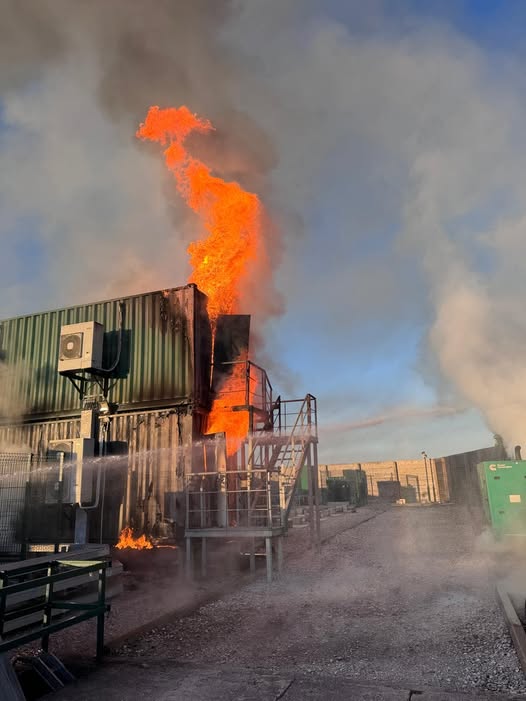
Anticipating resident pushback, and to address fire safety concerns, Aypa emphasized its safety approach, adhering to National Fire Protection Association (NFPA) standards (including NFPA 855) and UL 9540 certification. They stated BESS facilities emit no fumes, gases, or pollution during normal operations and planned extensive training for local first responders via third-party experts.
Property value studies by Kirkland Appraisals, LLC and Integra Realty Resources-Indianapolis concluded the project would not adversely affect surrounding property values, noting the closest residence was around 400m or 1,310 ft from equipment. Visual screening, landscaping, and noise minimization measures were also part of the proposal.
Despite these arguments and staff recommendations for approval with conditions, the Hamilton County BZA’s unanimous vote denied the variance. The Hamilton County Reporter suggested that more than 100 people were present for the public hearing.
A review of the more than two-hour meeting, available on YouTube, showed only three people spoke in favor, and at least 30 against, either asking the board to deny the petition outright or order a continuance so further questions could be answered by the developer. Many brought up fire risks and soil and water contamination concerns.
One resident expressed specific concern about tornadoes and the BESS units being mounted on a slab, fearing a tornado could pick up the boxes. Another was concerned by Aypa Power’s ownership by Blackstone, suggesting it’s a “private equity-backed industrial site with no long-term accountability.” Another claimed the private company will buy energy when demand is low and sell it back at inflated prices when high, affecting everyone’s monthly bills.
As of now, Aypa Power hasn’t appealed and hasn’t indicated its line of thinking, and ESS News did not receive an immediate response to a question about this.
Written by





Popular Posts