Jinko: Italy’s MACSE auction reflects bets on supply chain deflation, compressed IRRs

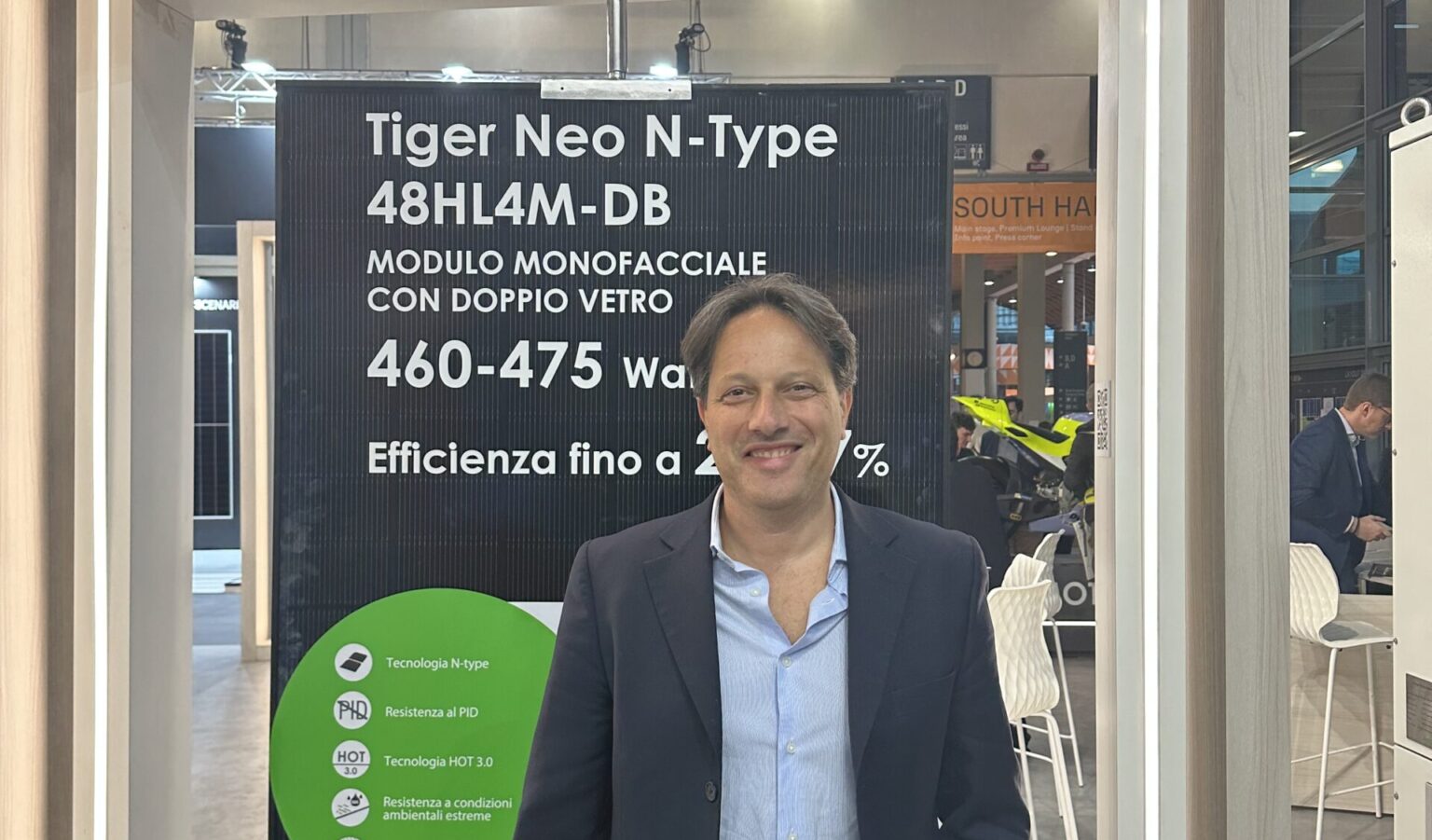
The results of the first MACSE auction indicate the long-term strategy of operators who believe in the Italian battery energy storage system (BESS) market. Felice Lucia, country manager for Italy at Jinko Power, told pv magazine Italia those operators have a strong interest in strategically positioning themselves in the market and expect battery prices to decrease in Italy and elsewhere in the coming months.
“It’s true that utilities have dominated but the issue isn’t just financial: it’s a supply chain issue which has offered incredible reductions to 2027, considering that the plants are due to start operating in 2028,” said Lucia.
Not all the big players in the storage market lodged successful bids, noted the Jinko representative, adding dozens of operators missed out, “including very solid funds and companies.”
Running the numbers, Lucia said the offers bid in the MACSE auction don’t fit with current storage costs in Europe.
“With the MACSE results (€12,000 per megawatt-hour, per year to €15,000/MWh/year), a four-hour system generates approximately €50,000 per megawatt, per year to €60,000/MW/year in fixed revenues for 15 years,” said Lucia. “If these flows are discounted in a simple way, the maximum sustainable capex [capital expenditure] to maintain economic and financial equilibrium is in the order of €60 per kilowatt-hour-installed to €80/kWh, considering low opex [operating expenditure] and connection costs.” The Jinko manager said European storage costs currently sit between €120/kWh and €180/kWh.
“So the auction result cannot be explained by current numbers but by two very specific bets made by the winners,” said the Jinko manager. “On the one hand, supply chain deflation: In China, turnkey prices are already at $66/kWh for tenders of more than 1 GWh, and LFP [lithium iron phosphate] cell costs have dropped below $60/kWh. The 2026 to 2027 trajectory points to $80/kWh to $100/kWh for a complete system in scaled-up scenarios. On the other hand, there is also an acceptance of compressed IRRs [internal rates of return]: many operators have chosen to sacrifice immediate profitability in order to enter the market, counting on the fact that the MACSE guarantees a long-term floor.”
Lucia believes capex of €60/kWh to €80/kWh is achievable by 2026 to 2027 but only if operators are willing to accept very low margins in exchange for strategic positioning and for gigawatt-hour-scale projects with direct Chinese supply.
“For most European projects, a more realistic trajectory is above €60/kWh in 2026–27,” Lucia added.
Successful bidders, said Lucia didn’t “close the accounts with today’s costs.” They calculated their subsidized batteries – which don’t have to be installed until 2028 and which can capture other, non-MACSE marginal revenue – will benefit from further global price falls.
That sort of strategy ensured the final MACSE prices undershot most industry estimates, said Lucia, adding, “Almost all analysts were talking about clearing [prices] of €25,000[/MWh/year] to €28,000[/MWh/year]. Bloomberg even went as far as €21,000[/MWh/year]. The actual result (€12,000[/MWh/year] to €15,000[/MWh/year]) shows that the classic models (LCOS [levelized cost of storage], IRR, Cost of New Entry (CoNE)) didn’t hold up.”
The low price in the bidding round was led by Enel which, according to Lucia, focused on brownfield projects with low management costs.
“These are projects developed domestically and with cost reductions on a global scale,” said the Jinko rep. “The alternative interpretation, which few have grasped, is that this isn’t just an Italian auction, it’s a global test. Prices reflect the trajectory of Chinese tenders ($66/kWh, turnkey) and the integration of Asian gigafactories, not current European costs. It will be a momentous shift that will rewrite the European energy market. For the first time, the game is becoming industrial on the construction side, taking into account that development has little value in the development of BESS systems. The same should be true for photovoltaics but constant regulatory changes are achieving the opposite.”
From pv magazine Italia.
Written by



Popular Posts