Pilot project in German lab tests high voltage battery storage system at up to 20 kV

“We need to increase the voltage!” Martin Kiel, professor of renewable energy and the fundamentals of electrical engineering at the Dortmund University of Applied Sciences, uses that simple formula to describe the approach pursued by the KV-Batt research project to increase the efficiency of battery storage systems.
The reasoning is that so many battery cells are interconnected, particularly in large systems, that the voltages of around 1 kV that are common today are far too low. Very high currents are generated in large battery modules thanks to the formula P/V=I (power divided by voltage equals current). Those currents cause high resistance, and thus efficiency losses.
By contrast, higher voltages lead to lower currents and lower resistance for the same power.
As a result, KV-Batt researchers are working on increasing the voltage in a battery storage system “by a factor of 10, perhaps even by a factor of 20,” a statement from the Dortmund University said.
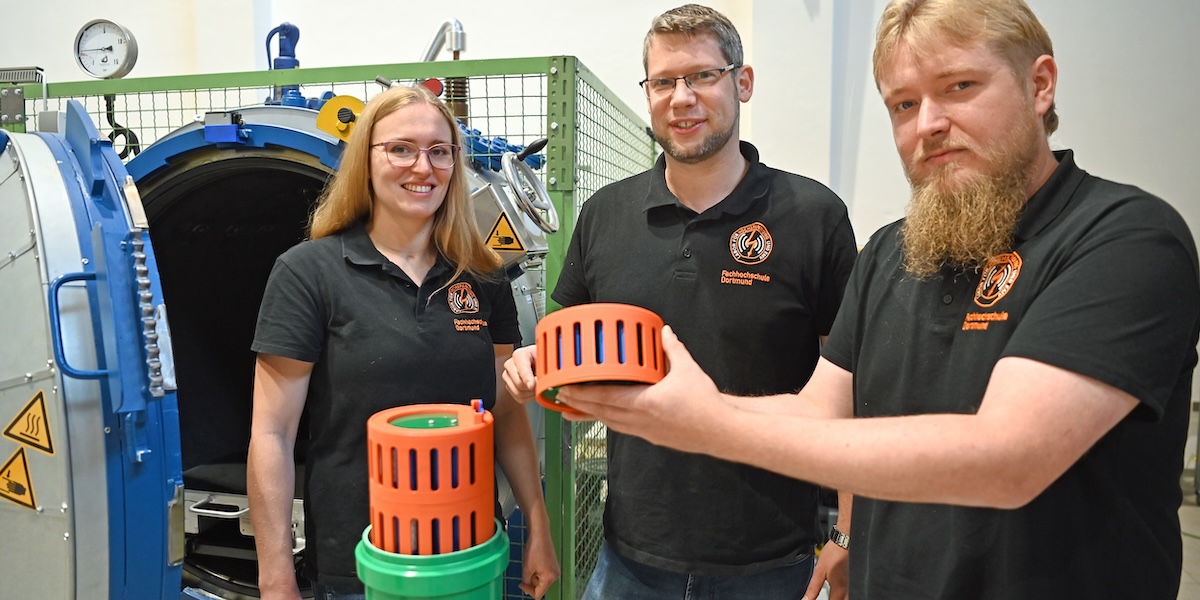
Over the past two years, the academics have developed a modular battery storage module and successfully tested it in the high-voltage laboratory under various environmental conditions.
Now comes the testing in practice. In the Sauerland municipality of Ense, a pilot under realistic conditions with two battery storage systems is being built with local municipal utility Ense Werke, AEG Power Solutions, and Weissgerber Engineering. One of the systems will work with a conventional 1 kV voltage and the other with 10 kV to 20 kV.
“We will then not only see lower losses but we will also be able to test under real conditions how the high voltage affects the service life of the batteries and how we can improve the balance of the individual battery cells with good battery monitoring,” said professor Kiel.
It is hoped the avoidance of resistance losses will not be the only benefit established by the testing program. Lower resistance generates less heat meaning lower requirements for cooling and therefore reduced internal energy consumption by battery systems. The module developed by the researchers does not require active cooling and is also more compact than conventional systems.
The university said the module also offers “almost maintenance-free operation.”
With a European patent procedure underway, the researchers claim their approach “will herald a small revolution in battery storage systems.”
From pv magazine Deutschland.
Written by





Popular Posts