MACSE could cost ‘nothing’, creating competition between BESS and pumped storage while sidelining hydrogen

At the first auction under MACSE, the outcomes caught even seasoned analysts off guard. The average winning bid was €13,000 per MWh-year, a 65 percent pricedrop from the ceiling price, turning a regulatory process into a strong market signal. With this result, Italy became the first major European country to prove that battery storage can compete on cost.
(Editor’s note: MACSE (Meccanismo per l’Approvvigionamento di Capacità di Stoccaggio Elettrico or Electricity Storage Capacity Procurement) is Italy’s national mechanism for procuring battery energy storage system (BESS) capacity through competitive tenders, managed by grid operator Terna. The first completed 10 GWh auction under the scheme was announced on October 1, 2025.)
But that financial metric is just the beginning.
At the Italian Renewable Investment Forum in Rome, Luca Marchisio, Terna’s Director of System Strategy, unveiled a claim that could shift how we value flexibility. According to Terna’s simulations, MACSE might cost society nothing, because revenues from time-shifting services by the awarded batteries would cover all payments made under the mechanism.
“The batteries pay for themselves by what they do,” Marchisio said. A simple yet groundbreaking statement: flexibility is no longer a system burden, but a standalone, value-creating service.
Central to Terna’s analysis is what it calls the cost of transference — the cost to shift one megawatt-hour over time. In practical terms, it is the minimal spread between charge and discharge prices needed to make a full cycle profitable.
Using auction data, Terna estimates that figure at about €50/MWh, assuming €13,000/MWh-year fixed payment, 350 annual cycles, 15 percent conversion losses, and a power-to-capacity ratio of 1:7 (roughly 6.7 hours). This is a structural inflection point: for the first time, storage could replace peaking thermal plants at lower cost and without emissions — what Marchisio calls a “grid parity of time.”
Terna plans two further MACSE rounds in 2026 — one for lithium battery storage, another for new pumped hydro plants — along with one or two additional capacity-market procedures.
The two technologies answer different but complementary needs. Pumped hydro is ideal for seasonal storage: high upfront investment, long permitting, but extremely long life and large capacity, necessary during periods of variable renewables. Battery storage, by contrast, works in daily or sub-daily cycles: modular, fast to deploy, and already competitive in balancing and reserve markets.
Marchisio’s view is that they are not substitutes. “BESS absorb day-to-day volatility and provide short-term flexibility, while pumped hydro handles longer cycles and seasonal reserves,” he said. Some days pumped will win, but most days batteries will dominate the grid.
That leads to two pressing questions: volumetrically, are BESS and pumped hydro similar in energy density and land use? And with BESS costs falling, densities rising, and land demands shrinking, do batteries delay hydrogen’s large-scale entry?
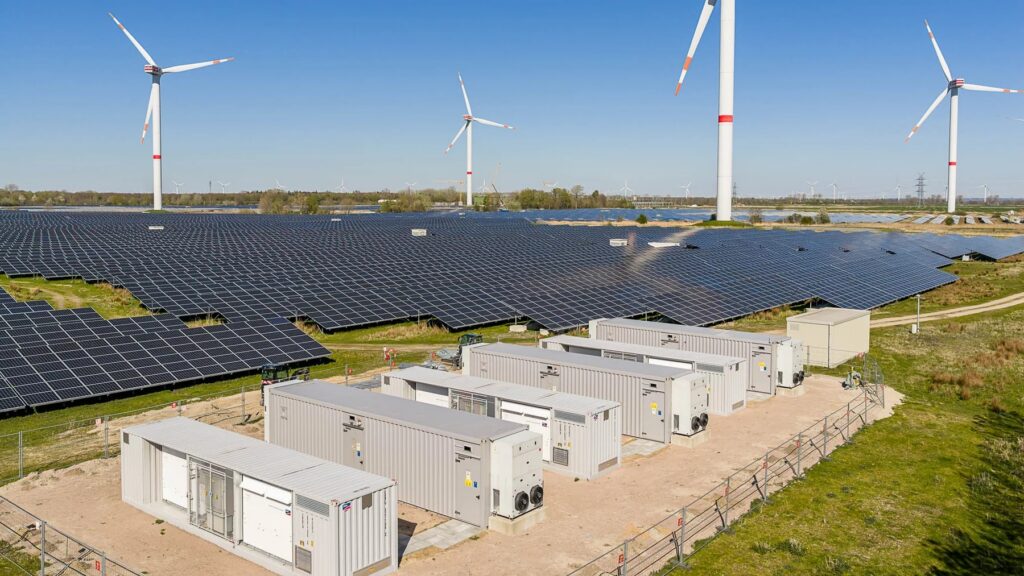
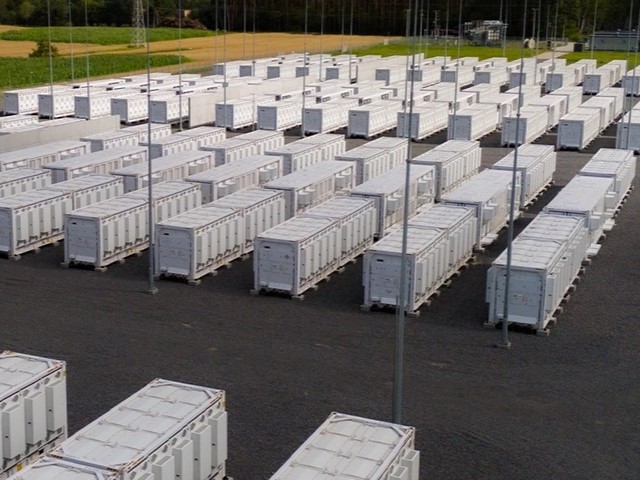
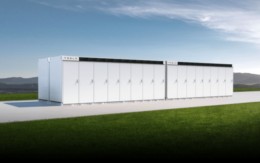
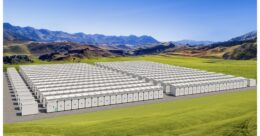
The gap is vast. A 5 MWh BESS today occupies about 35 m³. A pumped hydro system with 100 m head requires roughly 21,000 m³ of water — over 20 million litres. One cubic metre of batteries can store 600 to 700 times more energy than one cubic metre of water. In land terms, 5 MWh of pumped hydro needs ~0.2 hectares, while the same capacity in BESS fits on a simple industrial pad next to a substation, with no permanent civil works.
In density and logistics, BESS play a different game: scalable, transportable, reversible, compact and improving with each new generation. Every new battery chemistry increases volumetric density and lowers €/MWh cost, enabling distributed, compact storage integrated into grid nodes.
Thus, for multi-hour (or even multi-day) storage, BESS are far more efficient and falling in cost. Hydrogen will be pushed out of power-to-power space, i.e. where electricity is converted to hydrogen and back. Hydrogen’s strength will lie in seasonal storage, industrial cycles, chemical processes, and perhaps heavy transport — the hard-to-abate use cases.
Hybrid solutions are possible in the future, but now BESS are advancing faster. Every container installed today pushes further out the point at which hydrogen becomes electrically competitive.
So the future of flexibility is an ecosystem with shifting geometry: BESS in the short term, pumped hydro over medium and long spans, hydrogen in seasonal and industrial domains. If current trends hold, batteries will become the invisible backbone of the grid — the quiet structure enabling the energy transition not by ideology, but by physical and economic rationality.
From pv magazine Italia.
Written by




Popular Posts