Corrosion-free bromine flow battery promises longer life and higher energy density

Researchers at Dalian Institute of Chemical Physics (DICP), Chinese Academy of Sciences, have developed a new bromine-based flow battery chemistry that addresses one of the technology’s longest-standing barriers: severe corrosion caused by free bromine during charging. The team reports that the approach simultaneously extends cycle life and lifts energy density, potentially improving the commercial outlook for zinc–bromine (Zn/Br) flow batteries in long-duration energy storage.
Bromine flow batteries are attractive for grid applications because bromine is abundant, highly soluble and offers a high redox potential. In conventional systems, however, the charge reaction converts bromide (Br⁻) to elemental bromine (Br₂). The accumulation of Br₂ leads to aggressive corrosion of electrodes, current collectors and membranes, typically limiting cycle life to a few hundred cycles and forcing the use of costly, corrosion-resistant materials such as fluorinated membranes and titanium components.
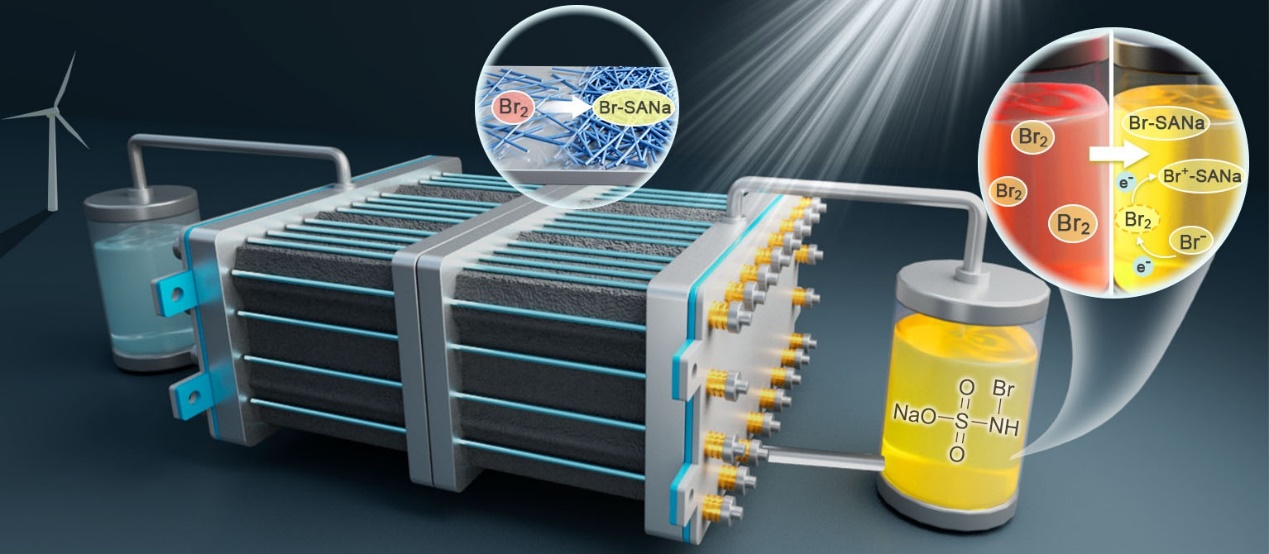
Led by researcher Li Xianfeng, the DICP team designed a two-electron bromine redox pathway that avoids free bromine accumulation. By introducing amine-based bromine scavengers with electron-withdrawing groups into the electrolyte, bromine generated during charging is rapidly converted into stable brominated amine species. This shifts the reaction from the traditional one-electron Br⁻/Br₂ couple to a two-electron Br⁻/Br⁺ process.
According to DICP, the concentration of free Br₂ in the electrolyte falls from several hundred millimoles in conventional systems to around 7 mM, effectively eliminating corrosion. The two-electron transfer also nearly doubles the theoretical energy density of the bromine catholyte.
The researchers validated the concept using inexpensive, non-fluorinated SPEEK ion-exchange membranes, demonstrating stable operation without observable corrosion of membranes, electrodes or current collectors. In a 5kW demonstration system, the battery operated at a current density of 40 mA/cm² for more than 700 cycles, delivering an energy efficiency above 78% – a level commonly cited as suitable for commercial flow battery deployment.
The work, titled “Grid-scale corrosion-free Zn/Br flow batteries enabled by multi-electron transfer reaction,” was published in Nature Energy. DICP says the results show that low-cost materials can replace corrosion-resistant components, potentially cutting system costs by more than 30%.
By combining longer lifetime, higher energy density and lower material costs, the new chemistry could improve the competitiveness of Zn/Br flow batteries against lithium-ion systems in applications such as renewable energy integration, grid balancing and microgrids. The team says the next step is scaling the technology toward megawatt-level pilot projects.
Zinc–bromine flow batteries store energy in circulating aqueous electrolytes containing zinc and bromine species. During charging, zinc metal plates onto the negative electrode while bromine-based species are formed on the positive side. The technology is valued for its intrinsic safety, deep-discharge capability and suitability for 4–12 hour storage durations but has historically been constrained by bromine-induced corrosion – an issue the DICP team now claims to have largely resolved.
Written by




Popular Posts