Volatility returns: Battery revenues in March 2026

March marks the beginning of spring. As days grow longer, the first structural changes also become visible in the power market.
While average price levels rose only moderately, underlying price dynamics became more pronounced. Increasing solar generation led to frequent midday oversupply and recurring negative price windows, while sharp ramp periods in the morning and evening created regular price spikes.
After a relatively compressed winter, this shift resulted therefore in a more differentiated market structure – and with it, improved revenue opportunities for battery storage.
March in numbers
To quantify these opportunities, we evaluated simulated earnings for a representative 10 MW / 20 MWh stand-alone battery in Germany. As usually, isolated strategies were benchmarked against a forecast-based multi-market optimisation approach.
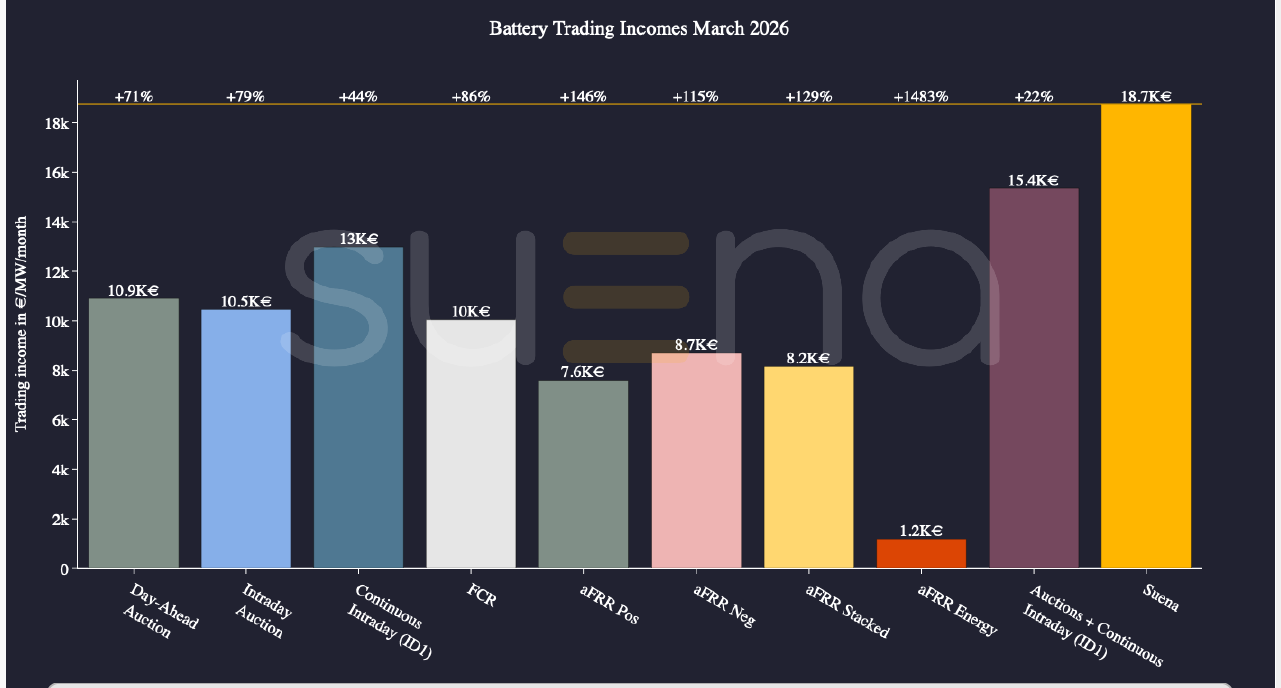
Continuous intraday trading emerged as the strongest single market, reaching €13k per MW/month. Day-ahead followed at €10.9k per MW, while intraday auctions delivered €10.5k per MW. Compared to February, this represents a clear step-up across all wholesale segments.
Ancillary services remained a stable value component, but at a significantly higher level than in February. FCR reached €10k per MW, while aFRR capacity products ranged between €7.6k and €8.7k per MW. In contrast, aFRR energy revenues remained limited at €1.2k per MW. As in previous months, value creation was driven primarily by capacity payments and spread capture rather than activation.
The strongest results came from combining markets. A stacked wholesale strategy – combining intraday auctions and continuous trading – reached €15.4k per MW/month. More advanced cross-market optimisation increased revenues further to €18.7k per MW/month. This corresponds to an outperformance around 22% compared to the combined wholesale spot strategy, and more than 140% compared to individual market strategies.
Behind the rebound
March’s performance was not driven by higher prices alone, but mostly by a change in how prices formed.
On the one hand, renewable generation – particularly solar – increased significantly. Midday oversupply became more frequent, with negative prices occurring in 35 hours throughout the month, compared to just seven in February. These periods created clear charging opportunities.
On the other hand, fossil fuel dynamics reasserted themselves. Rising gas prices, driven by geopolitical tensions in the Middle East, influenced price formation whenever gas-fired plants set the marginal price.
This effect was most visible during night and evening hours. With limited renewable supply, prices regularly reached €120-140/MWh at night and exceeded €200/MWh multiple times during the evening peak.
The result was a highly structured intraday profile. Low or negative prices at midday, followed by steep ramps and pronounced peaks later in the day.
Despite rising gas prices, average spot prices increased only moderately. A renewable share of nearly 60% ensured that price spikes remained limited to specific time windows rather than translating into sustained system-wide price increases.
A market of overlapping signals
This fragmentation of price signals across timeframes underscores the importance of multi-market optimisation. Different market layers reflect different underlying drivers – and with them, different value opportunities.
At the same time, these layers are not independent. They interact and reinforce each other, creating a highly interdependent market environment.
Renewables increasingly define intraday price patterns, particularly through solar-driven midday effects. Fuel markets introduce external risk and set marginal prices during periods of low renewable output. Balancing markets reflect real-time system needs, responding to short-term imbalances and forecast deviations.
For battery operators, value no longer comes from a single source. It emerges from the interaction between these layers. Performance therefore increasingly depends on coordination, dynamically allocating capacity across markets based on changing conditions.
More of the same – or more of both?
March provides a clear indication of what to expect as spring progresses. Solar-driven price troughs are likely to become more frequent as generation continues to increase, further expanding midday charging windows. At the same time, elevated gas prices and ongoing geopolitical uncertainty are expected to keep upward pressure on prices during hours with limited renewable supply.
This combination points to a continuation of strongly differentiated intraday price profiles: deeper troughs around midday and pronounced peaks in the morning and evening. For battery operators, this creates a favourable environment – but one that requires precise timing and coordination.
About the author:
Dr Lennard Wilkening is co-founder & CEO of suena energy, a green energy marketer for battery storage and renewables. suena offers marketing solutions that enable profit-maximizing multi-market trading and implement them through powerful trading algorithms. Lennard holds a PhD in grid-oriented use of battery storage systems from the Technical University of Hamburg and has more than nine years of experience in battery storage optimization and energy trading.
Written by