Enervis Battery Storage Index: German BESS revenues rebound in March amid Middle East tensions
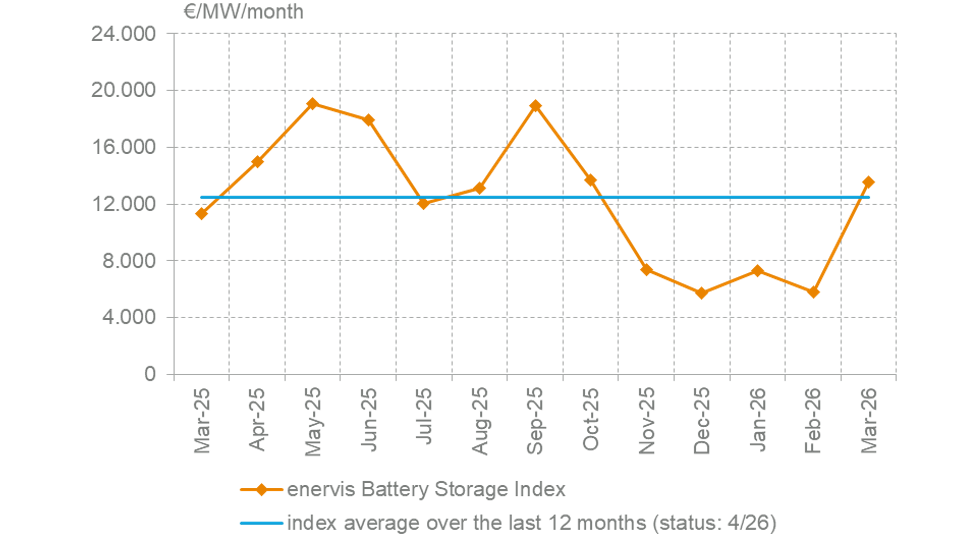
For one year now, enervis has been publishing a monthly Battery Storage Index based on historical market data, reflecting revenue opportunities for battery storage systems in Germany. The index is based on historical market data and illustrates revenue potential from participation in both the intraday market and the balancing power markets. For each month of the past 13 months, the respective achievable revenues are reported.
New revenue figures for March 2026
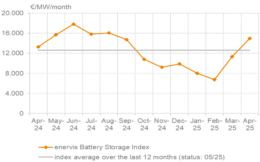
Following the weak winter months, achievable BESS revenues increased significantly in March, averaging around €13,500 per megawatt. This corresponds to an increase of 133% compared to February and is about 19% higher than the level of March 2025. Spreads in the spot markets increased significantly and were driven by higher volatility. A combination of the ongoing conflict in the Middle East, which pushed gas prices upward and consequently led to higher daily peak prices, as well as a renewed increase in PV generation, resulting in more frequent periods with very low or even negative prices, widened the spreads and improved arbitrage opportunities for battery storage. At the same time, FCR (Frequency Containment Reserve) and negative aFRR (automatic Frequence Restoration Reserve) prices rose again, further supporting the revenue potential.
General trends
Monthly achievable revenues have fluctuated considerably over the past 13 months. The maximum was reached in May 2025 at €19,100 per megawatt per month, while the minimum occurred in December 2025 at €5,700 per megawatt per month.
Battery revenues tend to be higher during the summer months. This is primarily due to strong photovoltaic generation during these months combined with comparatively lower overall electricity demand. In addition, conventional generation capacity is seasonally less available during summer, partly due to maintenance activities and potentially lower efficiency of gas-fired power plants at high temperatures. Wind availability is also typically lower during summer compared to winter or autumn months. As a result, short-term feed-in fluctuations or forecast deviations in PV generation during summer months lead to greater market volatility. This is directly reflected in more intensive trading activity in the intraday market.
Over the past twelve months, battery storage revenues averaged just below €12,500 per megawatt per month (approximately €150,000 per megawatt on an annual basis).
Expected revenues for 2026
Analogous to the approach used for the historical analysis, the Enervis Battery Storage Index also provides a forward-looking perspective. Based on our current power price forecasts, the operation of a typical stand-alone battery storage system is modelled for the year 2026.
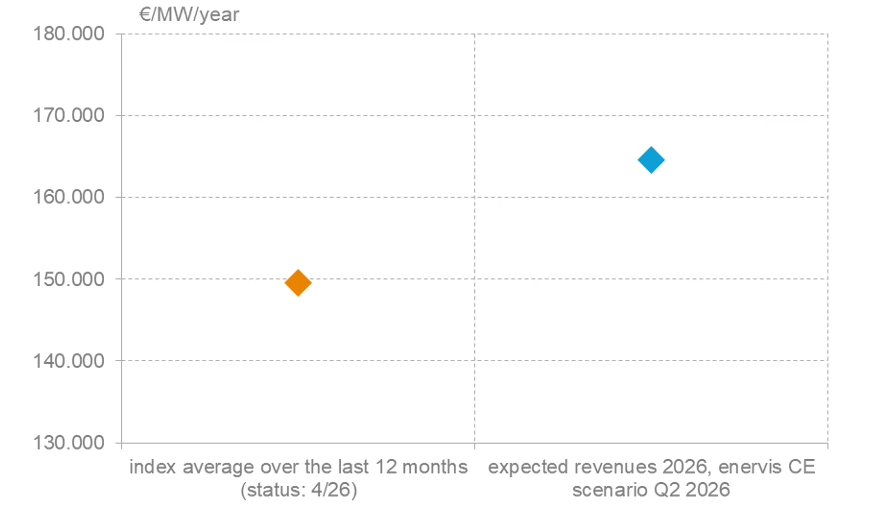
For the 2026 revenue potential, the underlying power price scenario from enervis has been updated to the Q2/2026 scenario. The modeled revenues in the new scenario are significantly higher than those in the Q1/2026 scenario. Overall, revenues increase by around €18.7k per megawatt, corresponding to an increase of approximately 13%. Higher short-term base prices as well as larger spreads in the spot markets, driven by upward adjustments to commodity price assumptions due to the current conflict in the Middle East, lead to this higher revenue level.
The forecast revenues currently amount to €164,600 per megawatt. This is about 10% above the average achievable revenues of the past twelve months. The storage parameters have been kept unchanged.
Methodological explanation: The Enervis Battery Storage Index shows the monthly net revenues that can be achieved historically and in the future in Germany for a 1 megawatt capacity and 2 megawatt hours storage volume (2 hours) battery storage system. The storage system was modeled with a use restriction of 1.5 cycles per day, a maximal depth of discharge of 90%, a technical availability of 97% and a round-trip efficiency of 87%. The index takes into account participation in the following markets: Intraday, Frequency Containment Reserve (FCR) and automatic Frequency Restoration Reserve (aFRR). Imperfect foresight and no revenues from aFRR energy are modeled. The respective prices of the markets for the historical analysis are taken from publications of the transmission system operators and EPEX-Spot. The future outlook is based on the same modeling and parameters and prices from the current Enervis power price scenario Current Efforts Q2/2026.
Further information:
If you are interested in a more detailed analysis and the full report, you can request it here.
Authors:
Mirko Schlossarczyk – Managing Director of enervis energy advisors is an experienced energy market expert. His consulting focus is on electricity price forecasts, electricity market scenarios and the asset valuation of BESS.
Jonas Anthonioz – Consultant at the energy economics consultancy enervis energy advisors, where he is responsible for battery storage-related topics. In addition to his usual tasks in revenue assessment and profitability analysis of battery storage projects, he developed the enervis BESS Index and the associated BESS Index Report.
Written by

Comments