German project tests DC-coupled commercial battery storage to cut costs

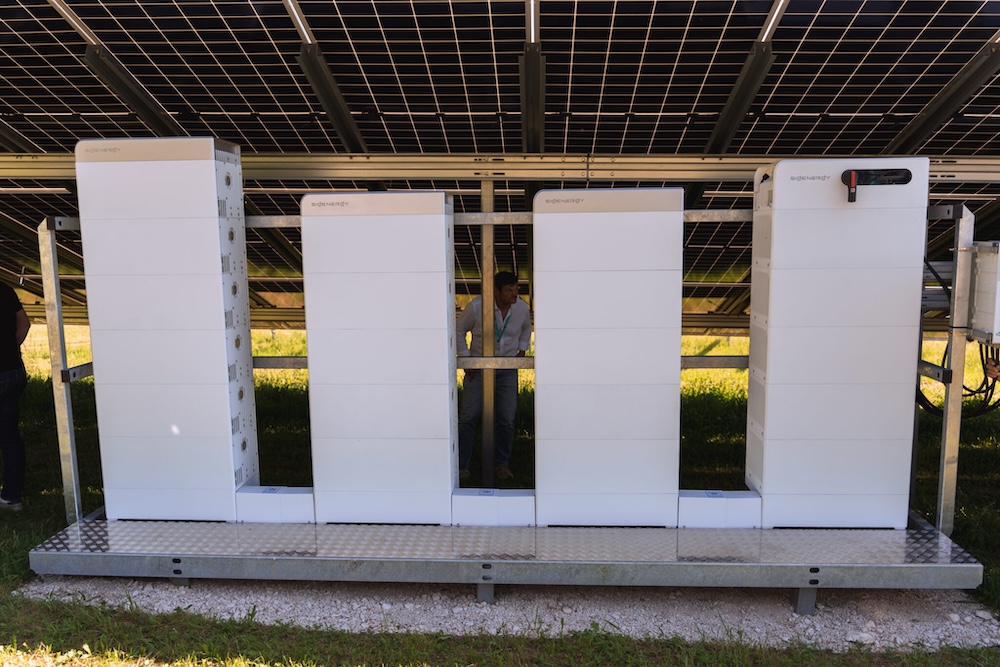
A research project in Widderstall, Germany, is testing DC-coupled commercial battery storage systems to assess whether they can reduce material use, improve system efficiency, and ease network connection constraints. Sigenergy, EnBW, and the Center for Solar Energy and Hydrogen Research Baden-Württemberg (ZSW) are conducting the project.
The system under test has a capacity of 252 kWh and uses Sigenergy’s Sigen Hybrid 60 M1-HYA hybrid inverters, which allow direct DC coupling between PV systems and batteries.
Compared to conventional AC-coupled architectures, DC coupling can reduce the need for power electronics. In a typical AC setup, a 100 kW PV system connected to a 50 kW grid connection would require 100 kW of solar inverters plus an additional 50 kW of battery inverter capacity, with export limits applied to manage grid injection.
With DC coupling, a single 50 kW hybrid inverter can manage both functions. If the PV system produces 100 kW, 50 kW can be converted and fed into the grid, while the remaining 50 kW is directly stored in the battery on the DC side, eliminating the need for a separate battery inverter.
Sebastian Feges of Sigenergy’s direct sales DACH team said battery storage has historically been dominated by AC-based designs, but argued the market is increasingly recognising that DC operation is both safe and more efficient.
The partners said AC-coupled systems require more hardware when PV systems are oversized relative to grid connection capacity, which often leads to smaller installations due to limited connection rights. DC coupling could therefore enable larger PV systems behind existing grid connections while using infrastructure more efficiently.
The project also explores mixed operating modes in which batteries are charged not only from onsite solar generation but also from the grid. This becomes relevant under Germany’s proposed “MiSpeL” regulatory framework, which is intended to define how stored electricity is tracked and allocated between renewable and grid sources.
However, under the current draft, DC-coupled systems are not eligible for the most flexible accounting option and can only use a simplified allocation model. The partners aim to demonstrate that DC-side metering could still enable accurate separation of green and grid electricity, potentially influencing future regulatory revisions.
More about
Written by


Popular Posts