Google-backed CO2 battery planned at Arizona power plant

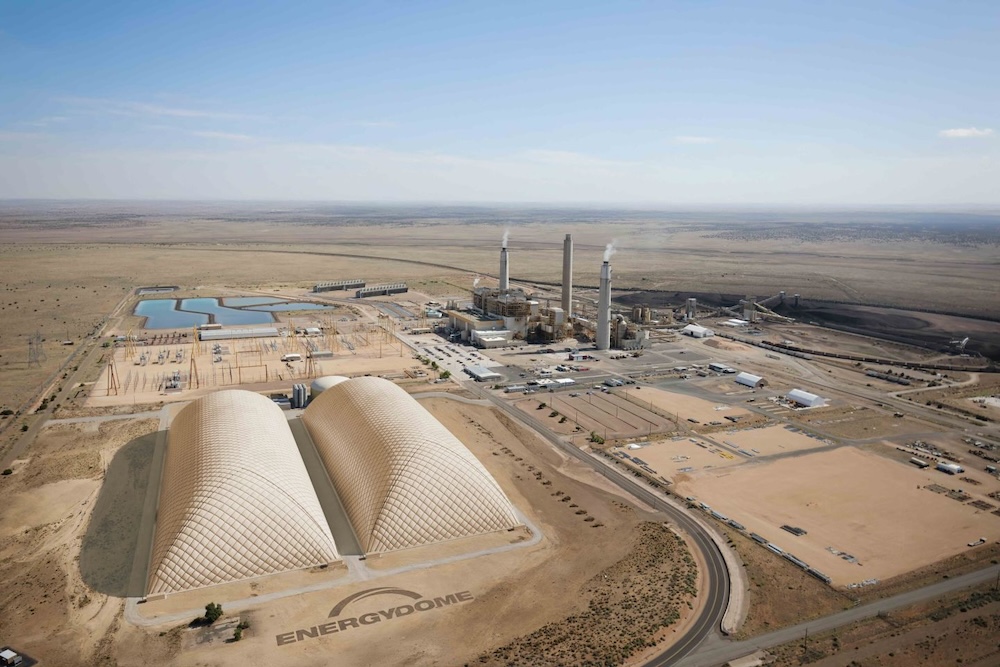
Italian long-duration energy storage company Energy Dome and Arizona utility Salt River Project (SRP) have announced plans to construct a 19 MW, 10-hour carbon dioxide-based battery storage project co-located at SRP’s Coronado Generating Station in St. Johns, Arizona.
Slated to come online in 2029, the pilot project is backed by a cost-sharing agreement with Google to accelerate non-lithium-ion long-duration energy storage (LDES) technologies.
The facility will be developed under a 20-year tolling agreement, with Energy Dome owning and operating the system while SRP dispatches its output.
Co-locating the battery at the Coronado Generating Station – a former coal plant being converted to run on natural gas – demonstrates the concept of using existing interconnection rights and transmission infrastructure from legacy fossil fuel sites for new storage capacity, avoiding lengthy interconnection queue delays.
Like other energy storage technologies, Energy Dome’s proprietary LDES technology is designed to store energy generated by intermittent sources such as solar and wind.
The technology uses electricity to compress and store CO2 in liquid form. When grid demand rises, the CO2 is heated and expanded, driving a turbine to generate power.
Energy Dome said the technology is designed to deliver power over eight to 24 hours, with a net roundtrip efficiency of 70%, meaning 70% of the AC electricity used to charge the facility can be recovered. While it has not disclosed specific figures, the company said the technology is cost-competitive with lithium-ion systems in long-duration applications.
Energy Dome was recently ranked third globally among LDES companies in a Sightline Climate leaderboard based on the amount of operational or under-construction capacity.
The company operates a demonstration facility in Ottana, Sardinia, that has been injecting electricity into the Italian grid since 2022. The primary off-taker for the project is European utility Engie.
In July 2025, Google announced a strategic partnership and equity investment in Energy Dome to support commercial deployments of the CO2 battery technology near its data centers across the Americas, Europe, and the Asia-Pacific region. The Salt River Project facility is one of the first named U.S. sites to emerge from that initiative.
Energy Dome is also pursuing U.S. deployments outside its Google partnership. Regulators in Wisconsin recently approved a 20 MW / 200 MWh project for Alliant Energy slated for completion in 2027, and the company has signed an agreement to deploy its technology at a 1 GW data center in Odessa, Texas.
From pv magazine USA
More about
Written by