Higher prices, different opportunities: battery revenues in August

As summer moved into its final stretch, the German power market remained anything but static. While August brought noticeably higher electricity prices, battery trading opportunities developed very differently across wholesale and ancillary service markets. Renewable generation remained high, while negative-price periods became less frequent. For battery operators, this set the stage for another strong month for cross-market optimization.
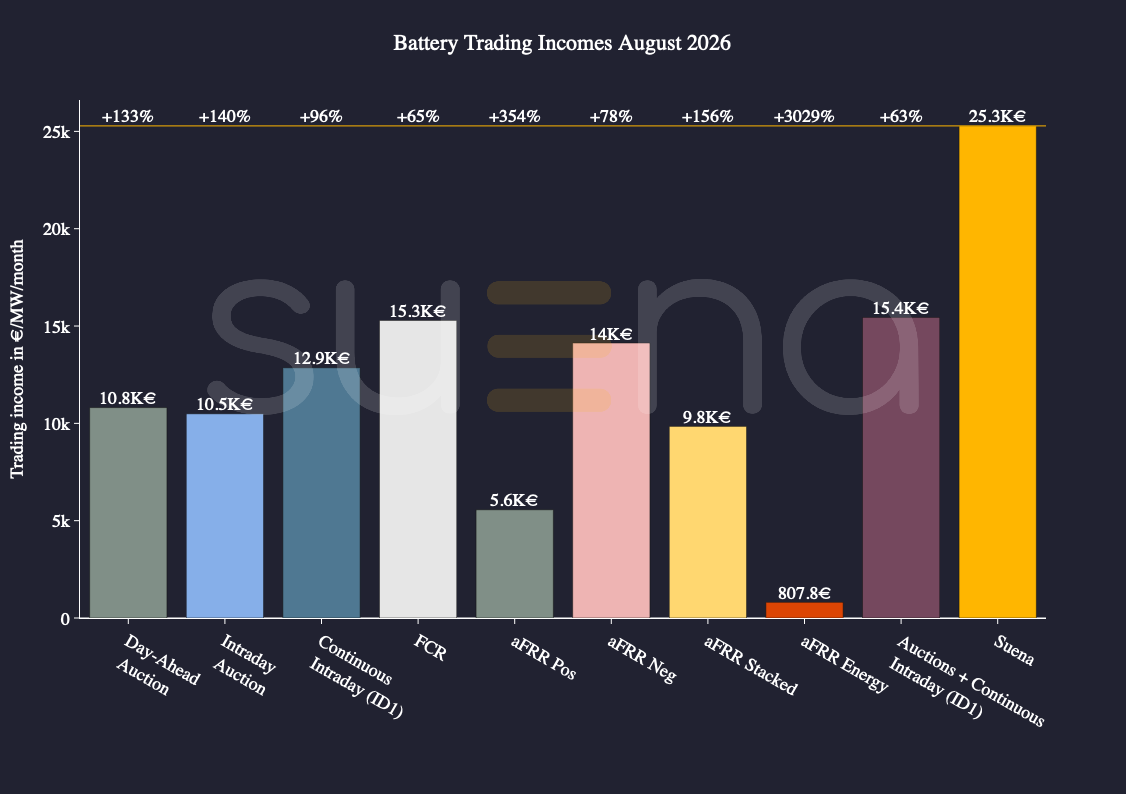
To quantify these developments, we evaluated simulated earnings for a representative 10 MW/20 MWh Grey Standalone Storage in Germany. As in previous months, individual market strategies were benchmarked against Suena’s forecast-based cross-market optimization approach.
Wholesale strategies weakened compared with July. Continuous intraday trading remained the strongest individual spot-market strategy at €12,900 ($14,710)/MW per month, although revenues declined about 10%. Day-ahead trading and intraday auctions, both at €12,300/MW per month in July, softened to €10,800/MW and €10,500/MW, respectively. The stacked wholesale strategy followed the same trend, declining from €17,100/MW to €15,400/MW per month.
Ancillary services presented a more mixed picture. FCR edged up to €15,300/MW per month, making it the strongest individual strategy in August. Negative aFRR also improved to €14,000/MW per month. Positive aFRR, by contrast, declined markedly to €5,600/MW per month, while the stacked aFRR strategy reached €9,800/MW per month. Revenues from aFRR energy remained comparatively low at about €800/MW per month.
The strongest overall result came from cross-market optimization. Suena’s approach generated €25,300/MW per month, 10% more than in July. This was 63% above the combined wholesale benchmark and 65% above FCR, the strongest individual strategy during the month.
Negative hours
August saw a clear increase in wholesale electricity prices. At over €126/MWh, the average day-ahead price was around €20/MWh higher than in July and roughly €50/MWh above the level recorded in August 2025. Among the main drivers were higher gas prices and tighter supply conditions in neighbouring markets such as France and Poland, where high temperatures, elevated demand and water-related constraints on power generation temporarily reduced the availability of electricity for imports into Germany.
Renewables nevertheless remained a defining feature of the German power market, accounting for roughly 70% of electricity generation, only marginally below July’s output. Strong solar output created regular charging opportunities during the day, while the first signs of the seasonal transition became visible. As daylight hours shortened, solar generation began to decline earlier while electricity demand remained elevated in the late afternoon and early evening. As a result, residual demand picked up earlier, making the spread between lower-priced midday hours and higher-priced evening periods more pronounced.
At the same time, negative-price periods became less frequent. Day-ahead prices fell below zero for 55 hours, compared with 79 hours in July, with these periods remaining concentrated around midday. This meant fewer deeply negative charging windows, even as higher-priced periods became more pronounced.
August also highlighted the importance of forecast accuracy. During the partial solar eclipse on Aug. 12, photovoltaic generation temporarily declined, but because the event was highly predictable, much of the effect could be anticipated by the market. By contrast, unexpected weather deviations produced much sharper price reactions. On Aug. 28, weaker-than-forecast solar and wind generation created a renewable shortfall of more than 10 GW around midday, pushing intraday hourly prices to around €500/MWh and individual quarter-hours above €3,000/MWh.
These changing conditions were also reflected in ancillary service markets. With periods of renewable oversupply becoming less frequent, the need for downward regulation increased in relative terms, supporting stronger revenues in negative aFRR. At the same time, opportunities in positive aFRR became less pronounced than in July.
The overall picture was therefore not simply one of higher prices. Rather, the timing of renewable generation, short-term scarcity and forecast deviations increasingly determined where trading opportunities emerged.
Beyond price
August underlines an important distinction for battery trading. Higher electricity prices do not automatically translate into higher revenues in every market. What matters is how those prices are structured across the day, how quickly market conditions change, and the ability to respond when the opportunities emerge.
The month also highlighted the growing importance of forecast accuracy. Predictable changes in renewable generation, such as the partial solar eclipse, can be anticipated by the market. Unexpected deviations, by contrast, can trigger much sharper price movements and create short-lived but valuable trading opportunities.
Looking ahead, the transition into autumn is likely to bring another change in market dynamics. Shorter daylight hours will reshape intraday price profiles, while changing weather patterns could increase uncertainty around renewable generation. For battery operators, the key will be to combine accurate forecasting with dynamic cross-market optimization as the timing and shape of value continue to change.
More about
Written by
Comments