Greece’s lack of battery storage policy hurting small and medium-sized PV asset owners

Wholesale electricity prices in Greece have collapse to zero or negative levels between 8 a.m. and 6 p.m, leading to significant volumes of renewable generation are being curtailed during these hours. This is hurting small PV producers, with the Greek electricity grid showing broadly flat demand, despite the country’s recovery from economic crisis.
Petros Tsikouras, organizational secretary of POSPIEF, a Thessaloniki-based association of Greek solar producers, told pv magazine that the current imbalance of production and demand is the result of policy decisions. “Over the past six years, the government pushed for massive over-licensing of renewable energy projects – up to 25 GW – in a system that consumes between 4 and 11 GW daily,” he said. He also criticized delays in establishing a functioning energy storage framework, saying these have undermined market stability.
The energy storage issue is an ongoing one, with ESS News covering it previously in “Greece struggles to connect battery storage projects” in early 2026, and “12 GW+ of merchant batteries wait for the green light as curtailments escalate” in March 2026.
Greece held its first battery storage auction in 2023, awarding 412 MW of capacity across 12 projects with significant subsidy support. Investors participated despite uncertainty over future market design, while the regulatory framework for battery operation was expected to be completed in the following two years, with operational deadlines set for 2025.
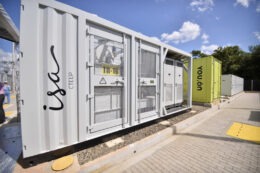
However, implementation lagged behind schedule. According to industry participants, regulatory delays left approved projects without a clear route to market participation. Some battery installations reached readiness by December 2025 but were unable to connect to the grid due to the absence of finalized operational rules. Authorities have cited the novelty of the technology and limited prior experience, though critics argue that sufficient time was available to prepare the framework.
Nevertheless, of the 412 MW of storage capacity awarded in the 2023 auctions, only two projects totalling around 16 MW have begun participating in Greece’s electricity markets as of April. The system operator has said that roughly 200 MW of additional stand-alone battery projects are now connected to the grid and undergoing testing ahead of imminent market participation. However, there is still no clear timeline for when these projects, or the remaining awarded capacity, will become fully operational in the market.
Tsikouras argues that the situation goes beyond administrative delay. “This is not only incompetence. It is politics,” he said. He described a system in which electricity is increasingly generated when it is not needed, while a lack of storage prevents shifting that energy to peak hours. “This creates winners and losers. Small- and medium-sized investors are the biggest losers, while a few energy companies that can generate power in the evening are the winners.”
He noted that in the evening hours—around 19:00 to 22:00—solar generation drops to zero, leaving gas-fired plants and large hydro units to set prices, which can spike to €170–€250 ($200-$294)/MWh. “This is why the government has been delaying energy storage for years,” he said.
Excerpted and edited from pv magazine Global.
Written by
Comments



Popular Posts