Steady but not static: Battery revenues in January 2026

Although a first glance at the numbers might suggest otherwise, 2026 did not begin uneventfully. On New Year’s Day, Germany recorded 2.5 hours of negative prices, driven by holiday-related demand reduction and temporarily elevated renewable feed-in. Yet this brief episode remained just that – an exception.
Unlike other European markets where negative-price phases were more concentrated towards the end of the month (Spain, for example, recorded extended negative periods in late January), the German market quickly returned to a more balanced winter pattern.
Still, steady did not mean static. Instead of sustained extremes, revenue opportunities emerged through more tactical trading around market dislocations across wholesale and balancing markets, once again rewarding strategies capable of coordinating flexibility across segments rather than relying on isolated price events.
January in Numbers
To quantify how this market environment translated into battery revenues, we evaluated simulated earnings for a representative 10 MW / 20 MWh stand-alone battery in Germany, comparing isolated spot and ancillary strategies with its forecast-based multi-market optimization approach.
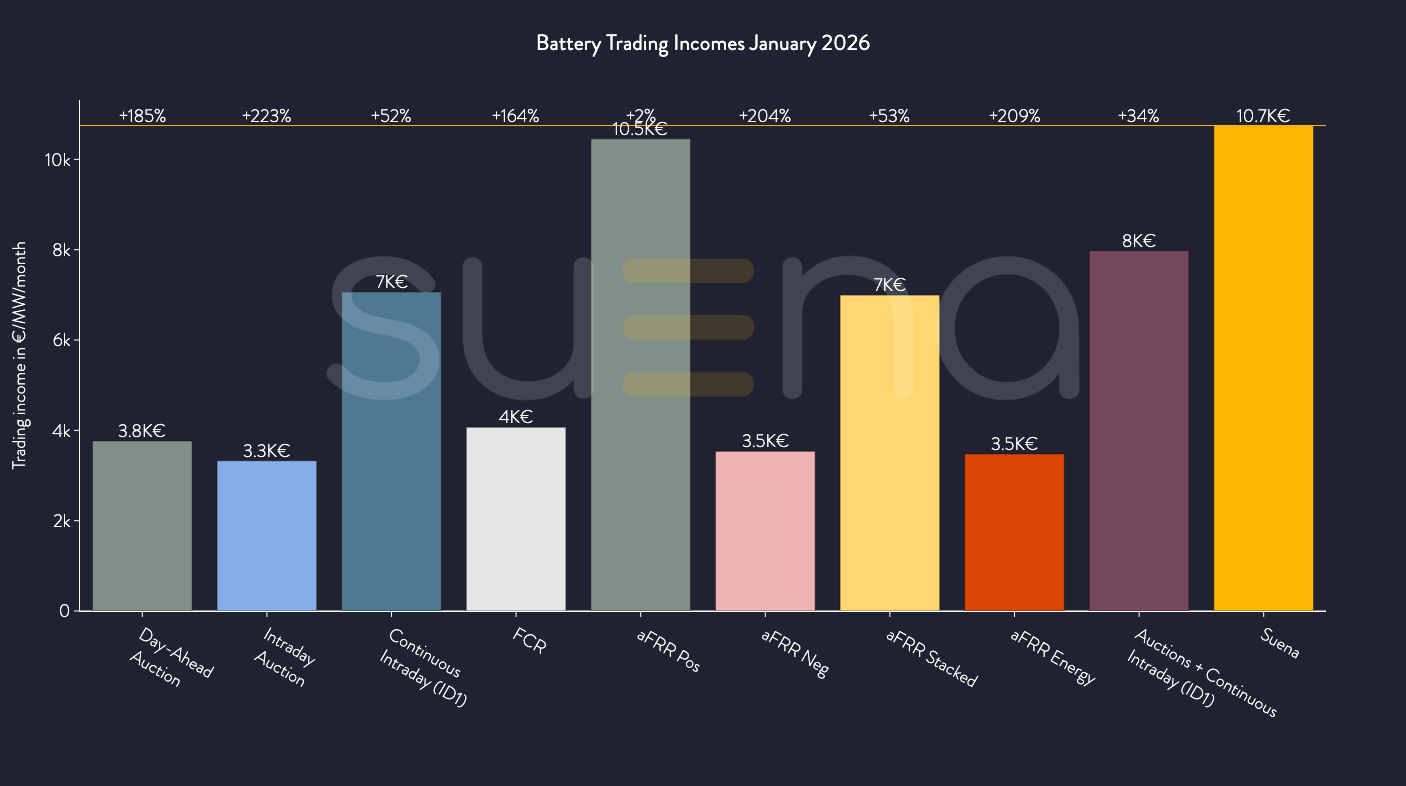
Across the wholesale markets, isolated spot strategies delivered between €3.3 and 7k per MW, with continuous intraday again leading performance at €7k per MW. In December, the same segment had reached €6.8k per MW, while the stacked wholesale benchmark (auctions plus continuous intraday) rose slightly from €7.6k per MW in December to €8k per MW in January, reflecting a moderate but stable spread environment across layers.
Ancillary services continued to provide a meaningful revenue pillar. FCR remained unchanged month-on-month at €4k per MW. Within aFRR capacity, positive capacity held steady at €10.5k per MW, while negative capacity and stacked aFRR settled at €3.5k per MW and €7k per MW, respectively – broadly in line with December levels, though without the stronger energy-driven uplift seen in previous months. The aFRR/PICASSO energy benchmark reached €3.5k per MW, compared to €4.3k per MW in December, indicating lower activation intensity.
In this winter setting, the suena Energy Trading Autopilot achieved €10.7k per MW, slightly below December’s €11.3k per MW, yet still demonstrating consistent cross-market value capture. Relative outperformance remained pronounced: 52–223% versus isolated spot strategies, 2–204% versus ancillary service products, with significantly stronger margins observed against aFRR negative than aFRR positive – and 209% versus the aFRR energy benchmark.
Below the Surface
January’s market regime was shaped less by prolonged stress events and more by repeated, short-lived price dislocations. Solid winter demand and limited structural oversupply kept average day-ahead prices elevated at around €100 per MWh. Negative price events were nearly absent – except for New Year’s Day. Beyond this isolated episode, oversupply did not materially influence market dynamics.
Compared to the volatility spikes towards the end of 2025, overall dispersion moderated. However, wholesale levels were firmer than in December, and spreads between day-ahead, intraday, and balancing markets widened, creating more frequent cross-market differentials. The period between 5 and 8 January 2026 illustrated this clearly, with prices approaching €280 per MWh and unusually wide spreads accounting for a disproportionate share of monthly wholesale earnings.
Fundamentally, load levels increased compared to December, while wind generation remained elevated and solar output improved from seasonal lows. The combination of stronger demand and renewable variability widened intraday spreads without producing prolonged scarcity phases or deep negative-price troughs.
Stability as a stress test
Months like January, that are characterized more by the absence of extreme price events rather than their occurrence, often serve as the more demanding test for battery strategies. Extreme volatility makes opportunity visible. Moderate dispersion requires systematic identification.
With fewer negative price hours and no prolonged scarcity blocks, batteries cannot rely on predictable midday charging troughs or multi-hour evening spikes. Instead, value emerges from repeated intraday micro-spreads, balancing energy activations, and tactical reallocation between wholesale and reserve commitments.
In such an environment, overcommitment to ancillary markets risks missing wholesale opportunities. Overexposure to spot markets risks foregoing stable balancing income. The ability to continuously rebalance between segments becomes the differentiator. This is precisely where algorithmic, forecast-based optimization demonstrates its structural advantage.
More granular opportunities ahead?
If the current winter regime continues, both wholesale and balancing markets are likely to remain constructive – not through dramatic price spikes, but through recurring dislocations.
At the same time, the seasonal transition toward higher solar output is likely to gradually reshape intraday structure. As daylight hours extend and midday generation increases, price profiles are likely to become more differentiated within a single day, potentially increasing the number of actionable intraday adjustments.
In such an environment, sustained performance is likely to once again depend less on singular price events and more on disciplined coordination across markets. Stability does not abolish revenue potential; it alters where it can be captured. Multi-market optimization therefore becomes the key performance driver.
About the author:
Dr Lennard Wilkening is co-founder & CEO of suena energy, a green energy marketer for battery storage and renewables. suena offers marketing solutions that enable profit-maximizing multi-market trading and implement them through powerful trading algorithms. Lennard holds a PhD in grid-oriented use of battery storage systems from the Technical University of Hamburg and has more than nine years of experience in battery storage optimization and energy trading.
Written by




Popular Posts