Long-duration battery storage can contribute to security of supply more cost-effectively than gas-fired power plants, LCP Delta finds

Discussions around capacity market procurements are gaining momentum. The European Commission approved Germany’s plan in January 2026 to procure 12 GW of new climate-neutral capacity this year. Of this, 10 GW is subject to a requirement to supply electricity continuously for up to 10 hours, while no long-duration criterion was imposed on the remaining 2 GW.
So far, however, the Federal Ministry for Economic Affairs and Energy has yet to launch the auction. Instead, it is reportedly exploring ways to allocate the full 12 GW exclusively to new gas-fired power plants, effectively limiting the chances for battery energy storage systems to secure contracts from the outset.
Against this backdrop, LCP Delta has conducted a study examining the contribution of long-duration energy storage systems – capable of meeting the 10-hour requirement – to security of supply, as well as their economic viability compared to gas-fired power plants. The analysis, commissioned by Field, is based on a reference scenario comprising 8 GW of new gas-fired capacity, 2 GW of long-duration storage, and 2 GW of conventional battery storage.
The authors stress that they are not advocating an either-or approach—relying solely on gas-fired power plants or exclusively on battery storage. “No electricity system can guarantee 100% security of supply at all times: gas and coal-fired plants can fail or require maintenance, battery systems may already be discharged when needed, and imports from neighboring countries can be disrupted,” said co-author Stefan Quentin of LCP Delta in response to a query from pv magazine. Ultimately, security of supply is a matter of probabilities.
Even so, the scenario offers several key insights. The study finds that long-duration storage systems can operate year-round, achieving higher utilization rates and generating more revenue than gas-fired plants. Given the significant decline in battery costs, they also require lower subsidies to become economically viable. These savings would ultimately benefit consumers.
According to LCP Delta’s analysis, replacing 2 GW of gas-fired capacity with long-duration storage could deliver annual savings of up to €166 million for consumers, while maintaining the same level of security of supply. In addition, battery storage systems can provide a broader range of services across system, market, and grid levels. While new gas-fired plants can also offer some of these services, they cannot match the flexibility and scope provided by long-duration storage.
Following the completed nuclear phase-out and the ongoing coal exit, Germany is set to lose a significant share of dispatchable fossil-fuel capacity in the coming years. Without new build, secured capacity could fall to just 36 GW by 2040, consisting entirely of gas-fired power plants. This would increase the risk of load loss.
The German government’s target is 2.77 hours of expected load loss per year, based on a given capacity mix, weather conditions, and demand patterns. This target was met in 2025, supported by a sufficient fleet of baseload power plants. However, without additional capacity, expected load loss could rise to more than 43 hours as early as 2030 and remain well above target at 18.8 hours in 2045. The authors note that this figure would gradually decline over time, driven by the expansion of battery storage and more flexible demand-side management.
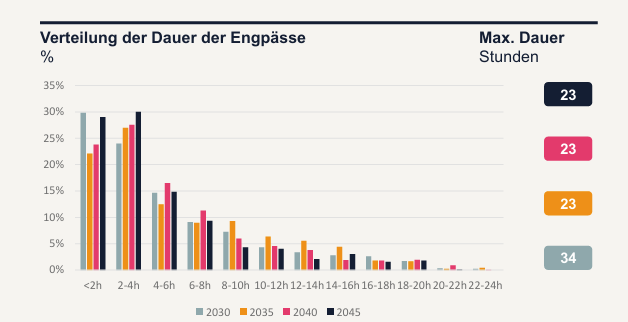
The study also assessed the duration and frequency of system bottlenecks throughout the year. It found that most bottlenecks are relatively short-lived: in modeled scenarios through 2045, between 82% and 87% of events last no longer than 10 hours, with half lasting less than four hours. The cumulative distribution analysis indicates that longer-lasting bottlenecks are more prevalent in the early 2030s than in the 2040s.
In addition, LCP Delta analyzed how much storage capacity would be required to replace 1 GW of gas-fired generation while maintaining the same level of security of supply. Assuming availability rates of 94% for gas-fired plants and 98% for battery storage, the required capacity ratio is above 1 for short-duration storage. Only for storage systems with durations exceeding 16 hours does the ratio approach parity, and for 20-hour systems it falls slightly below 1, reflecting their higher availability.
Based on net system costs, LCP Delta also quantified potential savings in subsidies – and, by extension, consumer costs. For a 10-hour storage system, net system savings are estimated at around €270 million between 2031 and 2050, driven by reduced fuel, CO₂, and import costs. For gas-fired plants, the comparable figure is around €70 million, before accounting for project costs.
The analysts estimate the average subsidy requirement for battery storage at approximately €31 per kW per year, compared to just under €100 per kW per year for gas-fired power plants. Their results suggest that replacing 2 GW of gas-fired capacity with 18-hour storage systems could save around €90 million annually in subsidy payments, while maintaining equivalent baseload capacity.
From pv magazine Germany
Written by
Comments




Popular Posts