Deye unveils 2.56 kWh hybrid battery for balcony, residential PV

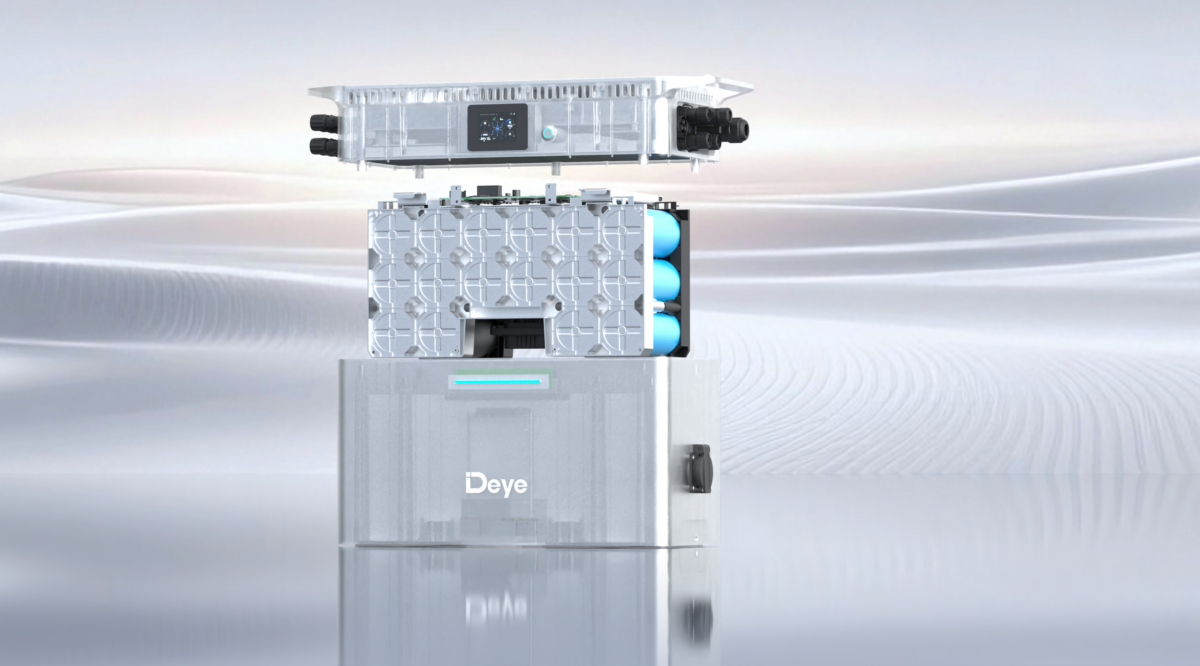
Chinese inverter and storage system manufacturer Deye has released a new hybrid storage system for plug-and-play solar and residential PV applications.
“The system supports AC coupling, allowing it to integrate seamlessly with existing solar panels or microgrids without requiring major rewiring or replacement of inverters,” the company said in a statement. “Individual 2.56 kWh units can be connected in parallel to form a three-phase configuration, supporting a maximum output of 7.5 kW.”
The 2.56 kWh Micro Hybrid ESS system measures 560 mm × 330 mm × 210 mm, weighs 30 kg, and complies with international standards including VDE 4105, IEC 61727/62116, AS 4777.2, CEI 0-21, and EN 50549-1.
The new product offers a rated AC output from 800 W to 2.5 kW depending on model, with up to 200% overload capability for 10 seconds to handle high startup loads. On the PV side, it supports up to 5.76 kW input across four MPPT trackers, with a maximum input current of 18 A and a PV voltage range of 20–55 V.
The rated PV input voltage is 42.5 V, with a 25 Vdc start-up voltage enabling operation under low irradiance. Depending on the variant, models range from 800 W up to 2500 W, with higher configurations supporting up to 4400 W PV access power and input currents up to 10 A.
The system is paired with a 2.56 kWh LiFePO₄ battery, operating within a 44.8–57.6 V range and supporting up to 50 A charge/discharge current. Designed for scalability, it can be expanded to five units per cluster and eight clusters in parallel, reaching up to 102.4 kWh total capacity. In off-grid mode, up to three inverters can operate in parallel, delivering up to 7.5 kW combined output and enabling three-phase configurations.
Deye said the units are rated for up to 10,000 cycles. Efficiency reportedly reaches 96.5%, while the IP65-rated enclosure ensures reliable operation in demanding environments, the company said. The system supports AC coupling for easy integration with existing PV systems and allows up to 30 A AC bypass current. Communication interfaces include Wi-Fi, Bluetooth, and LoRa, enabling flexible monitoring and networking.
Smart energy management is handled via Deye Cloud, which provides real-time monitoring, load forecasting, and dynamic energy scheduling, along with time-of-use optimization and intelligent operation via Deye Copilot. Users can monitor and adjust system settings through mobile, tablet, or desktop devices, improving visibility and control over energy flows.
Written by
Comments



Popular Posts