Germany’s battery storage-related grid connection requests swell beyond 500 GW

When pv magazine in February estimated Germany’s electricity transmission system operators (TSOs) – and three of its distribution system operators (DSOs) – were fielding more than 340 GW of grid connection requests from large scale BESS, there was talk of a “battery tsunami.”
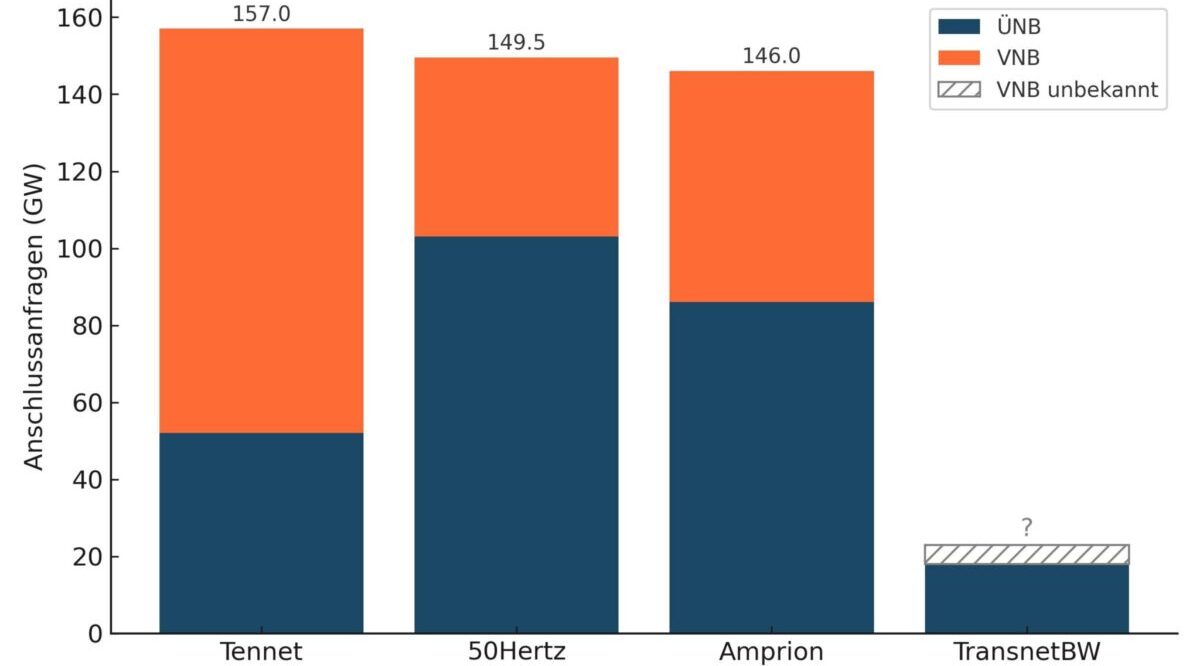
The Regelleistung (Control Power) -Online platform now estimates the total figure at 470.5 GW across the four TSOs and only three out of the nation’s 800 DSOs – Edis, Westnetz, and Mitnetz. This means that the total number at this point is far exceeding 500 GW.
The regional TSO picture is uneven, according to Regelleistung-Online, with 50 Hertz (with 103 GW of connection requests) and Amprion (86 GW) having significantly more grid applications than Tennet (52 GW) and Transnet BW (18 GW). That 259 GW total leaves 211.5 GW across the three DSOs.
“The more-than-500 GW of grid connection requests are not a realistic indicator for the market ramp-up of battery storage but, rather, a reflection of a misguided approval system,” stated Regelleistung-Online. “Instead of juggling ever-increasing numbers, we need a transparent, prioritized process that favors projects with a real implementation horizon.”
The online platform says those misguided incentives include a “first come, first served” approach, inadequate preliminary reviews, and high processing costs. Grid operators and project developers agree the current grid connection procedure is unsuitable and creates legal uncertainty, according to Regelleistung-Online.
Solutions include digitally-enhanced grid connection assessment, which would enable developers to check in advance whether connections would be possible at their proposed sites.
Regelleistung-Online said a uniform grid connection request process should include clearly regulated reservation fees, construction cost subsidies, and deadlines. Flexible, dynamic grid charges could reward the grid-friendly operation of storage sites, according to the online platform, and a national online portal for connection requests would accelerate the process and make it more transparent. Capacity auctions which prioritize project maturity, proximity, and system usefulness would also help, said Regelleistung-Online.
With the regulatory changes required to bring about such reform not in prospect at the moment, grid operators are trying to sort the wheat from the chaff themselves to thin out the number of grid connection requests. TSO 50 Hertz conducts feasibility studies to weed out unrealistic and technically unfeasible projects, and requests for BESS could also be transferred to option and waiting lists and sorted in line with criteria such as maturity, system benefit, or time of application.
Regelleistung-Online has also suggested grid operators begin charging reservation fees retroactively.
From pv magazine Deutschland.
Written by




Popular Posts