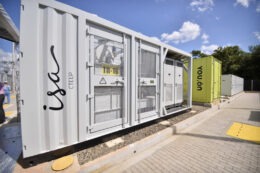
World-first 560°C Carnot battery unveiled as SPIC launches ultra-high-temperature heat storage


China’s State Power Investment Corp (SPIC) says it has commissioned what it calls the world’s first ultra-high-temperature heat-pump energy storage system, branded “Chuno,” after completing a megawatt-scale pilot and third-party performance testing.
SPIC’s Central Research Institute (also referred to as SPIC Science and Technology Research Institute Co., Ltd.) launched the technology in Beijing on Dec. 25, describing it as a “Carnot battery” concept that couples a heat-pump cycle with a heat-engine cycle to convert electricity into stored heat and cold, then back into electricity on demand.
According to SPIC, the pilot system is rated at 1 MW/4 MWh and has completed seven full charge–discharge cycles under third-party testing by Xi’an Thermal Power Research Institute (Xi’an TPRI). The company said the system met or exceeded design targets and remained stable during the test campaign.
SPIC says the system uses air as the working fluid. During charging, it uses electricity – typically off-peak or curtailed renewables – to “pump” heat to above 560°C while also generating cold down to -60°C. During discharge, the stored thermal gradient drives turbomachinery to produce electricity, and can also support combined heating/cooling/power applications where they are useful.
SPIC claims a scaled round-trip (electricity-to-electricity) efficiency of over 65% with no degradation in cycle efficiency across operating conditions, positioning the technology as long-life infrastructure rather than an electrochemical asset with capacity fade.
The system integrates high-temperature compressors, high/low-temperature turbines, ultra-high-temperature heat exchangers, molten-salt thermal storage, and controls. SPIC said it was supported by Harbin Electric on development of core equipment including the high-temperature compressor.
SPIC also reported an energy density of 80–120 kWh/m³ and said the approach can be deployed without the geographic constraints that limit pumped hydro or some compressed-air energy storage (CAES) projects.
SPIC said Chuno is pitched for grid-side long-duration storage to firm wind and solar output, as well as for flexibility services alongside thermal and nuclear generation. The company also highlighted industrial parks and other high-energy-use sites as targets, arguing that the ability to co-deliver heat, cooling, and power could improve project economics in sectors seeking decarbonisation pathways.
In remarks cited by Chinese media, SPIC framed the pilot as a step from lab research to industrial deployment, with experts at a review meeting describing the system as complete at the engineering validation level and backed by independent testing.
Written by





Popular Posts